
Edge Computing with Dell: Choosing PowerEdge XR Rugged Servers for the Field
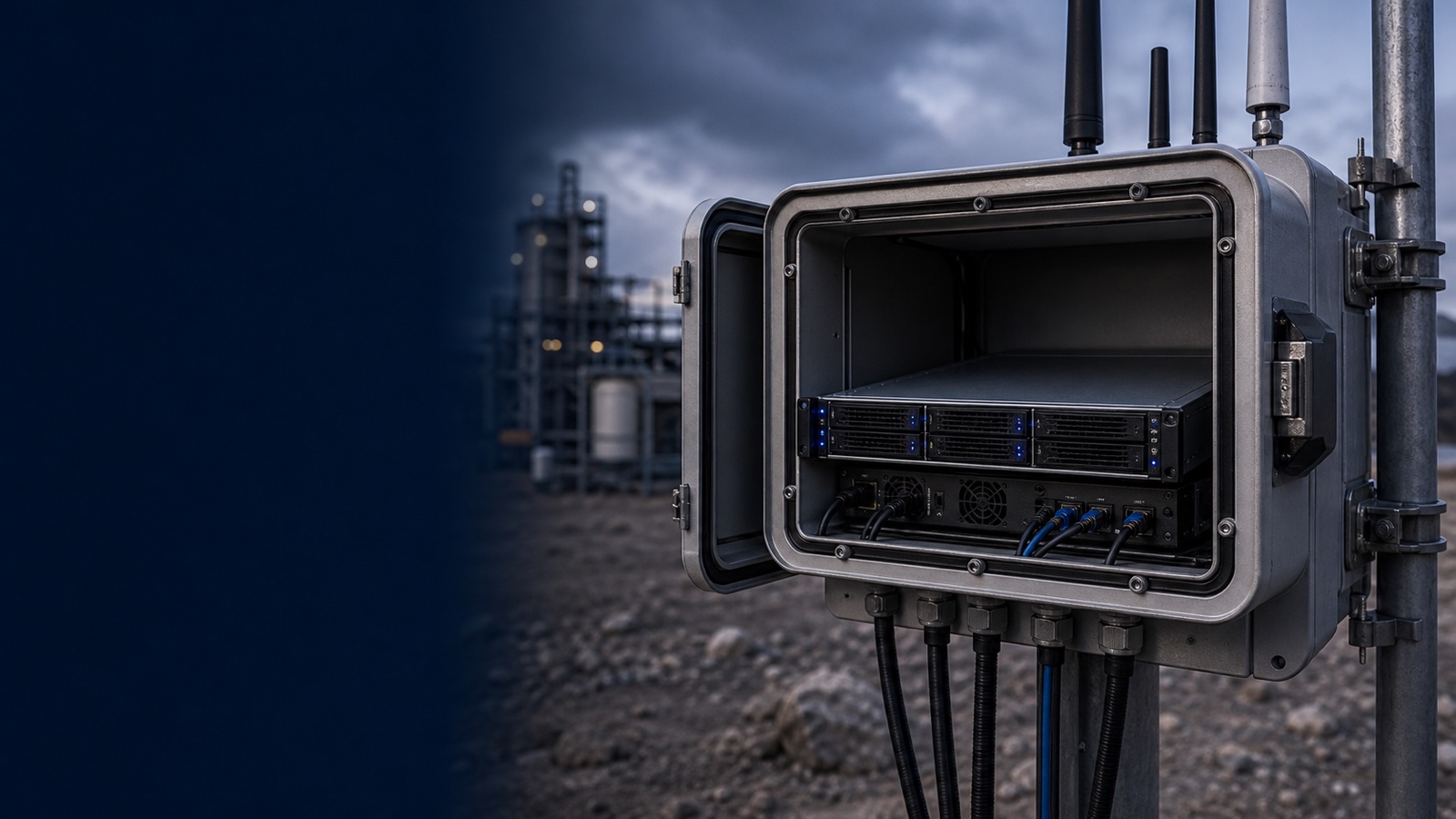
The compute is moving to where the data is born. Sensor fusion at a forward operating base, computer vision on a factory line, telemetry from a substation, imaging in a rural clinic — these workloads can't tolerate a round trip to a distant data center. But the racks that run beautifully in a climate-controlled facility were never designed for a dusty equipment shelter, a moving vehicle, or a cabinet bolted to a wall in 110-degree heat.
Dell's PowerEdge XR-series exists for exactly this gap. These are purpose-built ruggedized, short-depth servers that carry real Xeon and EPYC compute into environments where a standard PowerEdge R660 or R760 simply won't fit or survive. For IT decision-makers, sysadmins, and contracting officers scoping edge programs, here is how to choose the right XR platform.
Why standard rack servers fail at the edge
A mainstream PowerEdge R760 is roughly 30 inches deep and expects clean front-to-back airflow, conditioned power, and an ambient temperature that rarely strays outside a narrow band. The edge offers none of those guarantees. Common failure points include:
- Depth. Telecom cabinets, vehicle racks, and wall-mount enclosures are often 20 inches deep or less. A full-depth chassis physically does not fit.
- Thermal range. Equipment sheds and tactical shelters swing well beyond standard data-center specs. XR platforms are engineered for extended temperature operation and filtered airflow.
- Shock and vibration. Mobile and industrial sites subject hardware to constant vibration that loosens connectors and fatigues components rated only for a static rack.
- Power and contamination. Dirty power, dust, sand, and humidity degrade equipment built for a pristine room.
The XR line answers these with NEBS-aligned and MIL-STD environmental targets, short-depth chassis, filtered/sealed airflow options, and AC or DC power input — without giving up iDRAC management or the OpenManage tooling your team already runs.
The PowerEdge XR lineup at a glance
Dell's current-generation rugged edge portfolio spans several form factors. Match the platform to the physical and workload constraints of the site:
- PowerEdge XR4000 — a compact, modular chassis available in rack and wall-mount (zo) configurations, accepting multiple sled nodes. Ideal for retail back-rooms, branch sites, and space-constrained telco closets where you want several independent nodes in one short-depth enclosure.
- PowerEdge XR5610 — a 1U single-socket short-depth server tuned for telco RAN, defense, and AI inference at the edge. Supports GPU acceleration in a rugged footprint, making it a strong fit for 5G and real-time analytics.
- PowerEdge XR7620 — a 2U dual-socket platform built for heavier edge AI and video analytics, with room for accelerators and substantial local storage.
- PowerEdge XR8000 — a sled-based, multi-node telecom-grade design optimized for high-density edge and RAN deployments where you need to service nodes individually.
- PowerEdge XR12 / XR12+ — battle-tested short-depth 1U/2U workhorses for tactical and industrial roles that need broad expansion and extended-temperature operation.
For sites that need rugged endpoint compute rather than a server — a vehicle, a forward kit, a field technician — pair these with Dell Latitude Rugged laptops or Precision mobile workstations. The server, endpoint, and management stack all live in one vendor ecosystem.
How to scope the right XR platform
Work the decision in this order; each constraint narrows the field before you ever look at price.
- Physical envelope. Measure the actual cabinet depth, rack units available, and mounting method (rack, wall, or vehicle tray). Short-depth and wall-mount requirements often eliminate most of the catalog immediately.
- Environment. Document the real temperature range, dust/contamination, vibration profile, and whether power is AC, DC, or both. Confirm the platform's environmental rating covers the worst-case condition, not the average.
- Workload. Decide whether you're running inference/AI (favoring GPU-capable XR5610 or XR7620), general virtualization and containers, or lightweight data collection. Size CPU sockets, memory, and accelerators to the application.
- Storage and data path. Determine how much local storage you need at the edge and how data moves back to core. Edge nodes frequently feed a central PowerStore, PowerScale, or PowerMax array, with PowerProtect handling backup and cyber-recovery for the data that matters.
- Management at scale. Standardize on iDRAC for out-of-band control and OpenManage for fleet operations. At the edge, remote, lights-out management isn't a luxury — there may be no one on site for months.
Security and compliance considerations for government edge
For federal, DoD, and SLED buyers, the hardware decision is also a compliance decision. Build these into the requirement up front:
- Supply chain integrity. Dell's secured supply chain and signed firmware help satisfy controls expected under NIST SP 800-171 and related mandates. iDRAC provides a hardware root of trust and firmware verification that matter doubly in physically exposed locations.
- Procurement. Uniqcli supplies Dell to federal, DoD, and SLED buyers, quoted by RFQ, with TAA-compliant configurations available for covered programs.
- Cryptography. Where the requirement calls for validated encryption, specify FIPS 140-3 validated modules for data-at-rest and management-plane protection.
- Physical exposure. Edge nodes live outside the guarded data center, so treat tamper resistance, secure boot, and full-disk encryption as baseline rather than optional.
The practical takeaway
Don't try to force a data-center server into a field role, and don't over-buy a tactical chassis for a workload a single node could handle. Start with the physical envelope and environment, layer on the workload, and let those constraints point you to the right XR platform — XR4000 for modular branch and wall-mount sites, XR5610 or XR7620 for edge AI, XR8000 for telecom density, XR12 for rugged general-purpose roles. Then standardize management on iDRAC and OpenManage so a fleet of remote nodes stays governable from one console.
Edge programs live or die on getting these constraints right before the purchase order. If you're scoping a tactical, industrial, or remote deployment, request a quote or talk to a Uniqcli specialist — we'll help you match the right PowerEdge XR configuration to your environment and workload.