
Dell SafeID and SafeGuard: Layered Endpoint Protection for Commercial Clients
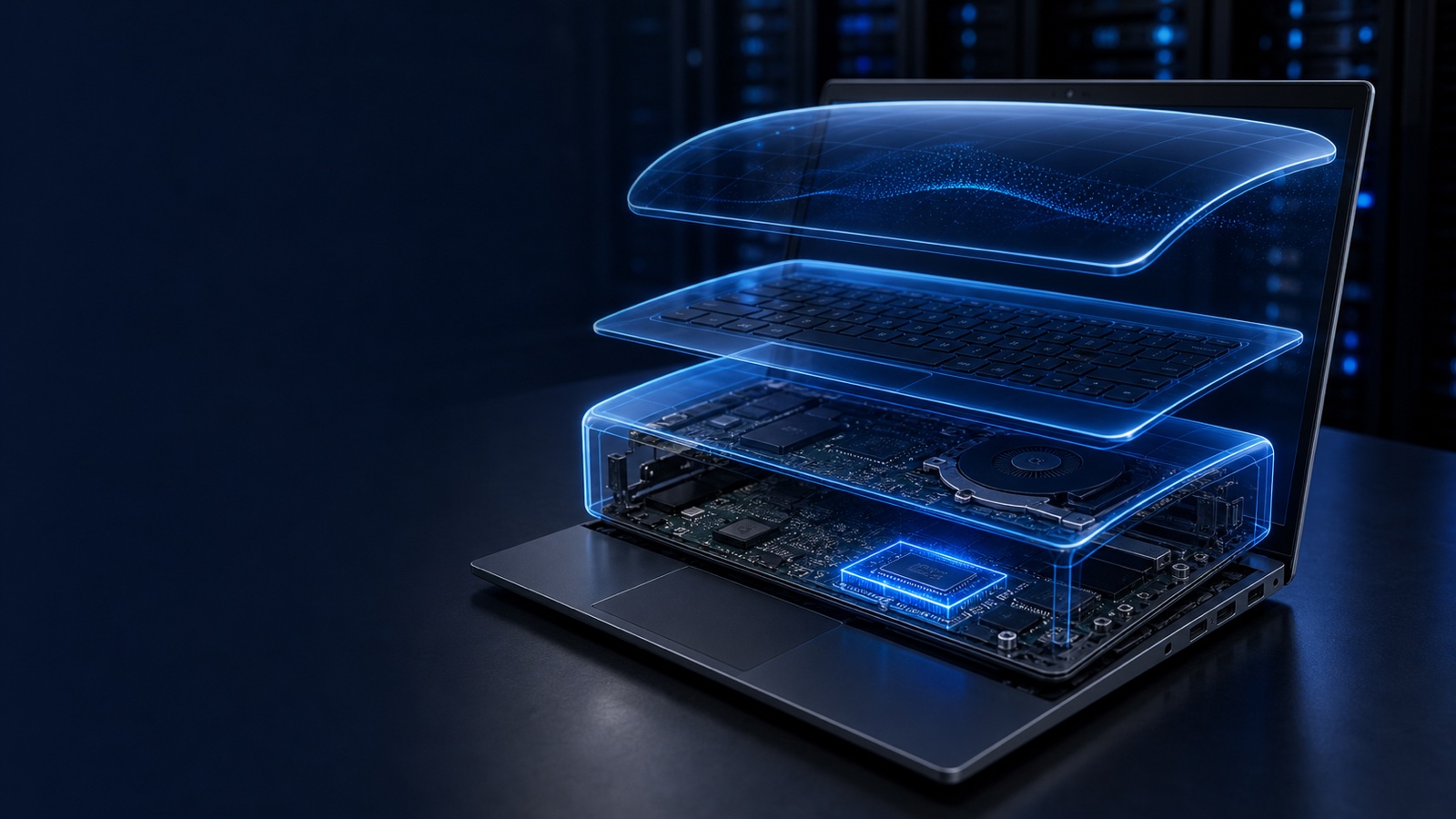
For agencies and enterprises, the endpoint is where the attack surface is widest and the visibility is thinnest. A Latitude laptop in a field office, a Precision workstation processing controlled unclassified information (CUI), or an OptiPlex desktop on a hospital network all sit outside the data center's hardened perimeter. Dell's commercial security portfolio — marketed under the Dell SafeBIOS, SafeID, and SafeGuard banners — is built around a simple architectural premise: protect the device below the OS, in the OS, and above the OS, because attackers no longer politely confine themselves to the application layer.
This post breaks down how those layers work together on Dell commercial endpoints and why that matters for IT decision-makers, sysadmins, and contracting officers evaluating fleets for federal, DoD, SLED, healthcare, and enterprise use.
Below the OS: SafeBIOS and the hardware root of trust
Firmware is the new frontier for persistent attackers. A compromised BIOS survives reimaging, evades most endpoint detection and response (EDR) agents, and gives an adversary control before the operating system — and your security stack — ever loads. NIST has formalized this concern in SP 800-147 (BIOS protection) and SP 800-193 (platform firmware resiliency), and Dell's SafeBIOS suite is its answer.
Dell SafeBIOS on Latitude, Precision, and OptiPlex platforms provides:
- Off-host BIOS verification — instead of asking a potentially compromised BIOS to attest to its own integrity, Dell takes a measurement and compares it against an official Dell signature in the cloud, off the host. A mismatch flags potential tampering for your security operations team.
- BIOS Image Capture and BIOS Indicators of Attack — telemetry that surfaces suspicious configuration changes and feeds them into your SIEM or EDR workflow.
- Intel Boot Guard and a silicon-based root of trust that anchor the boot chain in hardware, so each stage validates the next before execution.
- Chassis intrusion detection and tamper-evident features for physical attack scenarios common in shared, kiosk, or forward-deployed environments.
For contracting officers, the relevant point is that this verification happens on a hardware root of trust the OS cannot override — exactly the kind of supply-chain and firmware-integrity control that NIST 800-171 and zero-trust mandates increasingly expect.
At the identity layer: Dell SafeID
Credentials remain the single most abused entry point in real breaches. Dell SafeID addresses this by isolating authentication secrets in a dedicated ControlVault hardware chip rather than leaving them resident in main memory or on the general-purpose CPU, where malware can scrape them.
SafeID, built on Dell's ControlVault, processes and stores end-user credentials — passwords, biometric templates from the fingerprint reader, and smart card or CAC/PIV data — inside that isolated secure element. The practical security benefits:
- Authentication factors are handled off the main CPU, shrinking the window for memory-scraping and credential-theft malware.
- FIPS 140 validation on the ControlVault component supports federal and DoD authentication requirements where validated cryptographic modules are non-negotiable.
- Native support for CAC and PIV smart cards maps directly to federal PIV-based access control and DoD common access card workflows.
For an agency standing up phishing-resistant, hardware-backed multifactor authentication, SafeID provides the device-side anchor that complements your IdP and PKI.
Above the OS: Dell SafeGuard and Response
The third layer assumes — correctly — that some threats will still reach the operating system. Dell SafeGuard and Response is Dell's portfolio of software-layer endpoint security, delivered in partnership with established security vendors and centered on next-generation, AI-driven threat prevention and EDR.
Rather than reinventing the SOC tooling market, Dell integrates and ships these capabilities so they arrive configured and supported on Dell hardware:
- Next-generation antivirus and AI-based threat prevention that block malware pre-execution rather than relying solely on signatures.
- Endpoint detection and response (EDR) for hunting, investigation, and remediation across the fleet.
- Managed and professional services options for organizations that lack the staff to run detection and response around the clock.
Because SafeGuard sits above SafeBIOS and SafeID, the three layers reinforce each other: SafeBIOS guarantees the platform booted clean, SafeID protects the credentials used on it, and SafeGuard watches what happens once users and applications are running.
Managing it at fleet scale
Layered controls are only useful if you can deploy and monitor them consistently. Dell intends these features to be managed rather than babysat device by device:
- Dell Trusted Device (the agent formerly associated with the Dell Client Command Suite) collects BIOS verification and Indicators of Attack telemetry and can feed it to your security console.
- Integration paths exist to surface SafeBIOS attestation into Microsoft Intune, common SIEM platforms, and EDR consoles, so firmware health becomes part of your conditional-access and compliance posture rather than a separate silo.
- Dell Client Command Suite tooling supports scripted BIOS configuration, password management, and policy enforcement across large Latitude, Precision, and OptiPlex deployments.
This is where the endpoint story connects back to the data center. The same disciplined, attestable approach Dell applies to server firmware through iDRAC and OpenManage — and to storage platforms like PowerStore, PowerMax, PowerScale, and PowerProtect — runs through the client portfolio, giving you one coherent integrity model from edge device to core infrastructure.
Why this matters for regulated buyers
For federal, DoD, SLED, and healthcare buyers, the SafeBIOS/SafeID/SafeGuard model lines up cleanly with the controls auditors actually ask about: firmware integrity (800-147/800-193), validated cryptography (FIPS 140-3), CUI protection (800-171), PIV/CAC-based identity, and supply-chain assurance. Specifying these capabilities at the configuration stage — rather than bolting on third-party agents after deployment — reduces both cost and the gaps that come from inconsistent tooling. Dell commercial endpoints are available to agencies as TAA-compliant configurations, quoted by RFQ.
The practical takeaway
Endpoint security is not a single product; it is a posture that has to hold below, in, and above the operating system. Dell's SafeBIOS, SafeID, and SafeGuard layers give you a hardware-anchored root of trust, isolated credential handling, and modern detection and response — managed centrally and aligned to the frameworks your auditors enforce. The win is buying it as an integrated, attestable system rather than a stack of disconnected tools.
Ready to spec a secure Latitude, Precision, or OptiPlex fleet with the right SafeBIOS, SafeID, and SafeGuard options for your compliance requirements? Request a quote or talk to a Uniqcli Dell specialist — we'll help you configure endpoints that pass the audit and the threat model.