
Self-Encrypting Drives in Dell Servers and Laptops: FIPS, OPAL, and Key Management
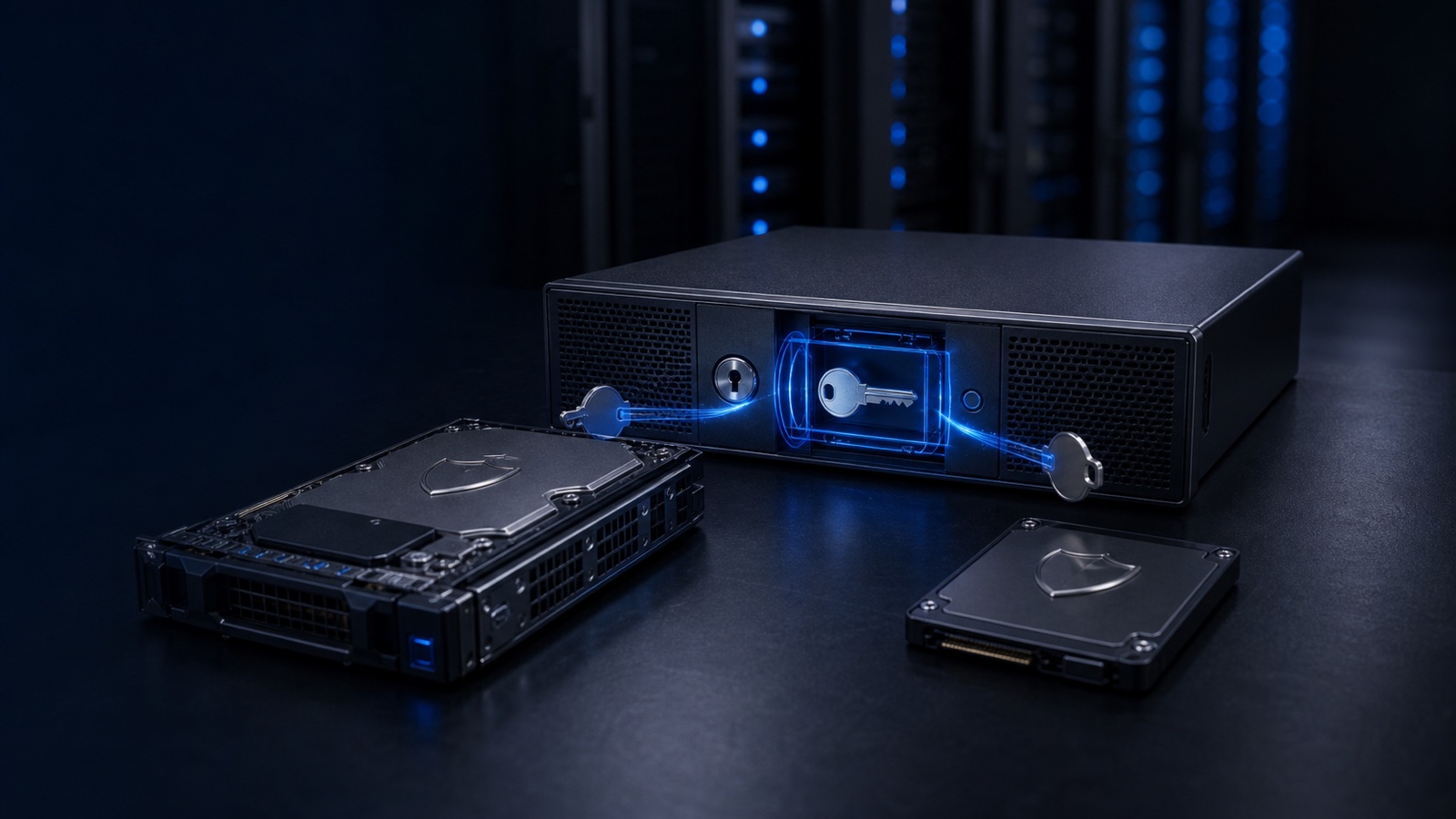
If a PowerEdge server or a Latitude laptop ever leaves your custody — returned off lease, sent for warranty repair, decommissioned, lost, or stolen — the data on its drives goes with it unless that data is encrypted at rest. Self-encrypting drives (SEDs) solve this at the hardware layer: the drive's controller encrypts every byte written to media, transparently, at full line rate, with no measurable performance penalty. For federal, DoD, SLED, and healthcare buyers facing NIST 800-171, FISMA, or HIPAA data-at-rest mandates, specifying SEDs at order time is far cheaper than retrofitting encryption later. This guide explains when to spec them, how FIPS and OPAL drives differ, and how key management actually determines whether your compliance story holds up.
What a Self-Encrypting Drive Actually Does
Every SED carries a Media Encryption Key (MEK) that never leaves the drive. Data is encrypted with the MEK on the way to the platters and decrypted on the way out — always on, even on an unlocked drive. What makes the drive secure is the Authentication Key (sometimes called the Key Encryption Key) that locks the MEK. Without it, the drive powers up locked and returns ciphertext.
This architecture gives you two practical wins:
- Instant cryptographic erase. Sanitizing a drive means deleting the MEK, not overwriting terabytes. A multi-terabyte drive is rendered unrecoverable in seconds — the difference between a same-day decommission and a multi-day wipe, and a clean answer for NIST 800-88 media-sanitization requirements.
- No performance tax. Encryption happens in the drive's ASIC, so there's no host CPU overhead and no throughput loss. This is the key reason to choose drive-level over software encryption for dense PowerEdge R660 and R760 nodes running storage-heavy workloads.
Hardware encryption also removes a class of risk that software encryption can't: the key material and crypto engine live inside the drive's controller, not in host memory where a compromised OS could reach them.
FIPS vs. OPAL: Two Different Promises
This is the distinction that trips up most spec sheets. FIPS and OPAL are not competing standards — they answer different questions.
OPAL is a Trusted Computing Group (TCG) specification that defines how a host manages and locks a SED — the command set for setting authentication keys, locking ranges, and enabling pre-boot authentication. OPAL is about manageability and interoperability. An OPAL drive gives you the locking behavior, the cryptographic-erase capability, and the standard interface that Dell's tooling expects.
FIPS 140 (now FIPS 140-3, superseding 140-2) is a NIST validation of the cryptographic module itself — independent lab testing confirming the drive's crypto implementation meets U.S. government standards. A FIPS-validated SED has been through the NIST Cryptographic Module Validation Program and carries a certificate number you can verify.
In practice:
- Most FIPS SEDs are also OPAL-compliant — you get the validated crypto and the standard management interface.
- An OPAL-only drive is not FIPS-validated. It encrypts correctly, but it hasn't passed the government lab testing that many federal and DoD programs require by policy.
- The rule of thumb: if a contract, ATO package, or agency security control references FIPS 140-2/140-3 for data at rest, you need FIPS-validated drives — OPAL alone won't satisfy the auditor. For commercial and most SLED/healthcare deployments, OPAL SEDs are frequently sufficient.
When you configure a PowerEdge or a Precision/Latitude on a quote, FIPS and non-FIPS SED options are distinct line items. Don't assume "self-encrypting" means "FIPS-validated" — confirm the certification explicitly.
Key Management: Where Compliance Is Won or Lost
A SED is only as good as the system holding its authentication keys. Lose the key and the data is gone; leave the key unmanaged and you've gained nothing over an unencrypted drive. Dell gives you a tiered set of options.
- Local Key Management (LKM) via the PERC RAID controller and iDRAC. The controller holds a key protected by a passphrase, managed locally through iDRAC or OpenManage. LKM is simple and free of external dependencies — well suited to single servers, edge sites, and disconnected enclaves. The tradeoff: the passphrase is your single point of failure, so it must be escrowed somewhere safe.
- Secure Enterprise Key Manager (SEKM) for fleets. iDRAC retrieves keys at boot from an external KMIP-compliant key manager, centralizing key lifecycle, rotation, and audit across many PowerEdge nodes. This is the right model when you're managing data-at-rest at scale and need to prove key custody to an auditor.
- Array-native key management on the storage platforms. PowerStore, PowerMax, PowerScale, and PowerProtect implement data-at-rest encryption with their own integrated or external (KMIP) key management — encryption is a property of the array, not something you bolt on per drive.
For laptops and desktops — Latitude, Precision, OptiPlex — the OPAL SED is typically driven by the OS or endpoint-management layer (for example, BitLocker leveraging the drive's hardware encryption, or a managed endpoint-encryption agent), with keys escrowed centrally so a forgotten passphrase doesn't mean a lost device.
Two practices separate real compliance from box-checking:
- Escrow every key. An unrecoverable key turns cryptographic protection into accidental data destruction.
- Match the validation to the mandate. FIPS-validated module plus a documented, audited key-custody process is what an assessor wants to see — the drive and the key management are evaluated together.
Practical Takeaway
Spec SEDs at order time, not after deployment — retrofitting drive encryption into a live fleet is expensive and disruptive. Default to OPAL for general enterprise and SLED use; step up to FIPS 140-3-validated drives whenever a contract, ATO, or security control calls out validated data-at-rest crypto. Then decide key management before the hardware ships: local (iDRAC/PERC) for standalone and edge systems, SEKM for managed fleets, and array-native encryption for PowerStore, PowerMax, PowerScale, and PowerProtect. Encryption without disciplined, escrowed key custody is not compliance — it's a liability waiting on an audit.
Uniqcli is an authorized Dell Technologies reseller supporting federal, DoD, SLED, healthcare, and enterprise buyers, with attention to TAA and FIPS requirements. If you're scoping data-at-rest encryption across servers, storage, or endpoints, request a quote or talk to a Uniqcli specialist and we'll help you spec the right SEDs and key-management model for your compliance posture.