
Zero Trust on Dell Infrastructure: From Silicon Root of Trust to Endpoint
Zero Trust is no longer a whitepaper aspiration. Under the DoD Zero Trust Reference Architecture and the accompanying strategy, agencies and their contractors are working toward defined target and advanced activities across seven pillars: User, Device, Network/Environment, Application/Workload, Data, Visibility/Analytics, and Automation/Orchestration. The guiding principle — "never trust, always verify" — assumes the network is already hostile and that no device, identity, or workload is trusted by default.
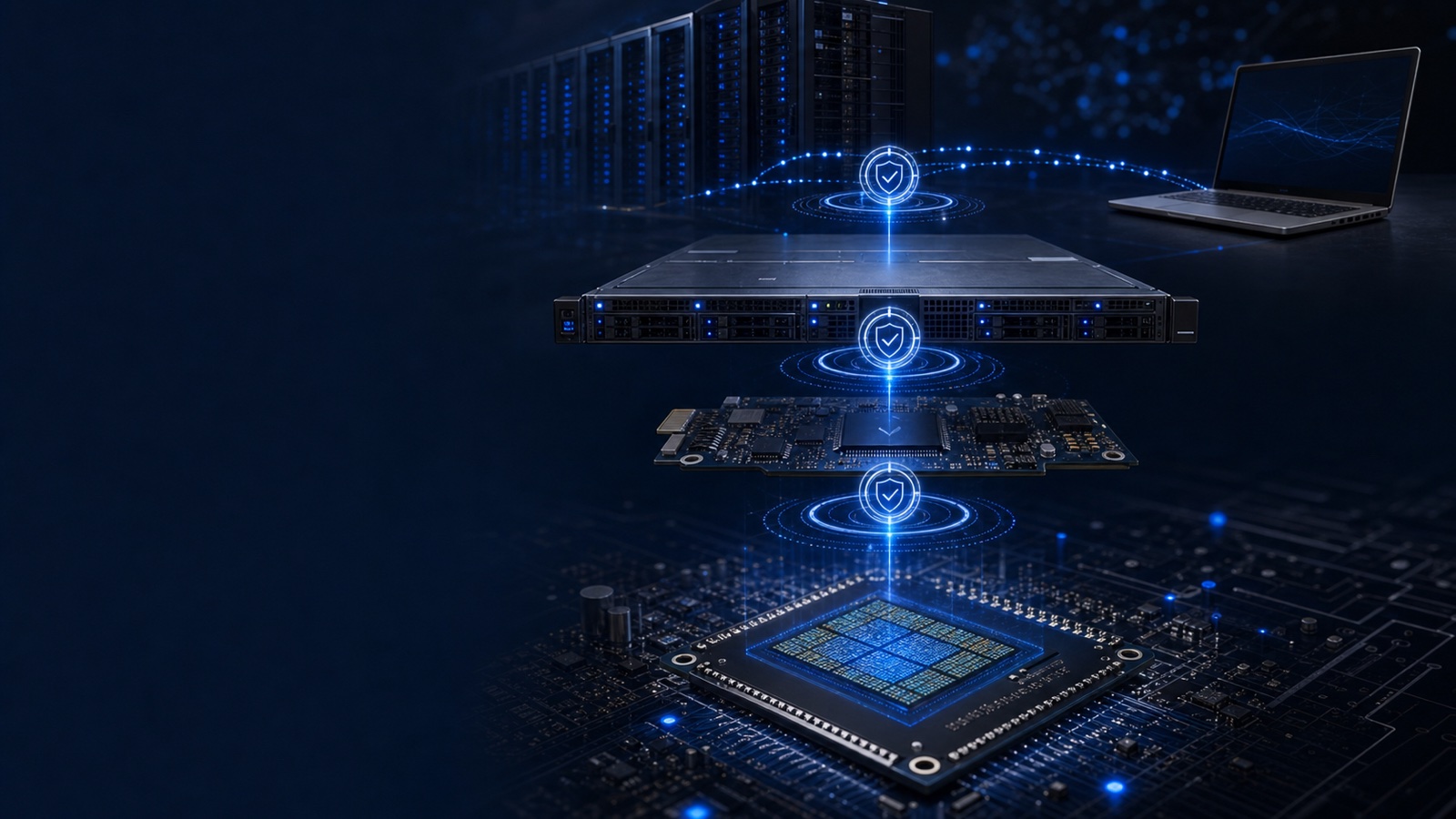
That principle only holds if the hardware underneath can prove it hasn't been tampered with. A compromised BIOS or a counterfeit component silently undermines every policy layer you build on top. This is where Dell's security architecture earns its place in a Zero Trust program: it pushes verification down to the silicon, then carries a verifiable chain of trust up through firmware, the OS, and the endpoint. Below, we map Dell's real capabilities to the pillars contracting officers and sysadmins are being asked to satisfy.
The Device Pillar Starts in Silicon
The DoD Device pillar requires that you identify, authenticate, and continuously assess the health of every endpoint and server before granting access. You cannot assess what you cannot trust to report honestly about itself.
Dell PowerEdge servers — including current R660 and R760 platforms — anchor that trust in an immutable silicon Root of Trust. At power-on, cryptographically signed firmware is validated against keys fused into the chipset before any code executes. If the BIOS or iDRAC firmware fails signature verification, the platform halts or recovers rather than booting a compromised image. This is the foundation of a hardware-rooted chain of trust, and it maps directly to the Device pillar's requirement for verifiable device health.
Supporting controls that contracting officers should ask about by name:
- Secured Component Verification (SCV) — a cryptographic certificate of as-shipped components that lets you verify, at receiving, that the server arriving on your loading dock matches what Dell built. This addresses supply-chain integrity, a recurring theme in 800-171 and NIST 800-161.
- iDRAC with a dedicated, isolated management plane for out-of-band identity, attestation, and lifecycle control independent of the host OS.
- TPM 2.0 modules for measured boot and key storage, available in FIPS 140-3 validated configurations for workloads that require it.
SafeBIOS: Continuous Device Health, Not One-Time Boot
A one-time secure boot check is not continuous verification. Zero Trust expects ongoing assessment, and firmware is a favored persistence target precisely because it survives OS reinstalls.
Dell SafeBIOS provides off-host BIOS verification: it captures a measurement of the BIOS and compares it against a known-good copy held off the device, so a compromised host cannot vouch for itself. SafeBIOS Events & Indicators of Attack surface configuration drift and tampering signals that can be fed into your SIEM. On the client side, the same philosophy extends to Latitude, Precision, and OptiPlex endpoints, giving Visibility/Analytics pillar telemetry from the firmware layer that most endpoint detection tools never see.
Practically, this means:
- BIOS integrity results become an input to conditional access and device-health policy.
- Firmware tamper indicators flow into Visibility/Analytics rather than dying on the endpoint.
- The chain of trust established at boot is re-verified over the device lifecycle, not just once.
Managing Trust at Fleet Scale with OpenManage
Zero Trust dies in spreadsheets. The Automation/Orchestration pillar exists because manual, per-device verification does not scale to a federal fleet.
Dell OpenManage Enterprise centralizes firmware compliance, configuration baselines, and security posture across PowerEdge at scale. It enforces driftless configuration baselines, automates signed firmware updates, and reports compliance state you can hand to an auditor. Paired with iDRAC's redfish APIs, OpenManage lets you treat server trust as code — policy-driven, repeatable, and logged. For contracting officers, that translates into demonstrable, repeatable evidence for an ATO package rather than point-in-time attestations.
Carrying Zero Trust into Data and Storage
The Data pillar asks you to inventory, classify, encrypt, and control access to data wherever it lives. Dell's storage portfolio brings hardware-rooted protections to data at rest and a recovery path when prevention fails:
- PowerStore, PowerMax, and PowerScale offer Data at Rest Encryption with self-encrypting drives and centralized key management; PowerMax configurations support FIPS 140-3 validated cryptography for classified-adjacent workloads.
- PowerProtect with Cyber Recovery provides an isolated, air-gapped vault with immutable copies — the resilience backstop a mature Zero Trust strategy assumes, because the architecture presumes some attempts will succeed.
- Granular, role-based access and audit logging on these platforms feed the Visibility/Analytics pillar with data-access telemetry.
Immutability and isolation matter here. A logically air-gapped PowerProtect vault means a credential compromise on the production side cannot reach the recovery copies — exactly the blast-radius containment Zero Trust is designed to deliver.
Acquiring It the Right Way
None of this helps if you cannot buy it cleanly. Uniqcli is an authorized Dell Technologies reseller, and we deliver these platforms to federal, DoD, SLED, and healthcare buyers with TAA-compliant configurations and FIPS 140-3 options specified at the line-item level. That keeps your Zero Trust hardware buy compliant and audit-ready from the purchase order forward.
The Practical Takeaway
Zero Trust is a chain, and a chain rooted in unverified hardware is no chain at all. Dell lets you start that chain in silicon — immutable Root of Trust and Secured Component Verification on PowerEdge R660/R760 — extend it with SafeBIOS continuous verification across servers and Latitude, Precision, and OptiPlex endpoints, orchestrate it through OpenManage and iDRAC, and protect the data itself with encrypted, immutable PowerStore, PowerMax, PowerScale, and PowerProtect platforms. Mapped against the DoD pillars, that gives you defensible answers for Device, Data, Visibility/Analytics, and Automation/Orchestration — not slideware.
If you're scoping a Zero Trust refresh or building the hardware section of an ATO package, request a quote or talk to a Uniqcli specialist about TAA-compliant, FIPS-ready Dell configurations, quoted by RFQ.