
Liquid Cooling for Dell AI Servers: When DLC Beats Air for GPU Density
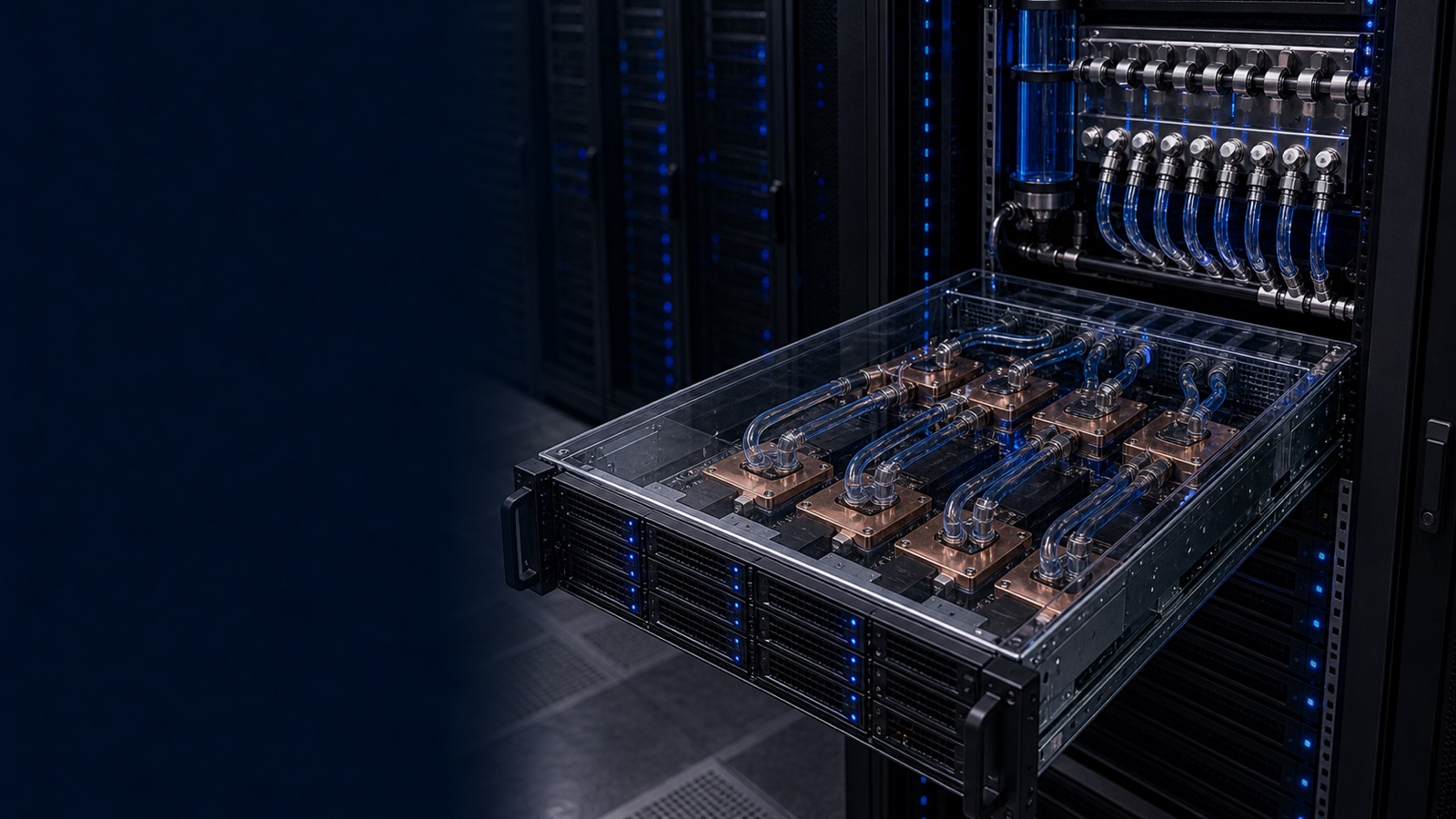
For most of the last decade, "cooling" was a non-decision in a server purchase. You racked a Dell PowerEdge R660 or R760, pointed cold aisle at it, and the fans did the rest. AI changed that. When you start packing eight high-wattage GPUs into a single chassis, air physics stops cooperating—and direct liquid cooling (DLC) moves from a luxury to a requirement. If your roadmap includes Dell PowerEdge XE-series GPU nodes for training, inference, or HPC workloads, the cooling choice now drives facility design, power planning, and your statement of work.
This guide covers where the air-to-liquid threshold actually sits, why it lands there, and the concrete facility changes DLC demands before the first node ships.
Where air cooling runs out of road
Air is a poor heat-transfer medium. It works fine until the thermal density in a rack exceeds what airflow can carry away, and modern accelerators blow past that ceiling fast. A single current-generation training GPU can dissipate 700 watts or more. Put eight of them in one chassis alongside dual high-core-count CPUs, NICs, and NVMe, and a single node approaches or exceeds what an entire conventional rack drew a few years ago.
The practical signals that you've outgrown air:
- Rack power density above roughly 30–40 kW. Traditional raised-floor cooling tops out here. Dense GPU racks can demand 80 kW, 100 kW, or more.
- High-TDP GPUs that throttle under air. When silicon hits thermal limits, clocks drop—you paid for performance you can't sustain.
- Acoustic and airflow limits. Pushing enough CFM to cool a 10 kW node makes fans scream and still loses the fight at the chip.
- PUE pressure. Air-cooled GPU halls burn enormous fan and chiller energy. Federal and SLED buyers under sustainability mandates feel this directly in operating budgets.
Dell positions its mainstream PowerEdge R760 and R660 servers for air-cooled general compute, and that's still the right answer for virtualization, databases, and most enterprise apps. The XE GPU platforms are where DLC enters the conversation—and for the densest configurations, liquid isn't optional.
Why DLC wins at GPU density
Direct liquid cooling pipes coolant—typically treated water or a water-glycol mix—directly to cold plates mounted on the CPUs and GPUs. Liquid carries roughly three to four thousand times the heat per unit volume that air does, so it removes heat at the source instead of fighting it across a chassis.
The payoffs that matter to a buyer:
- Sustained clocks. Cold plates hold silicon in its performance band, so a training run delivers the throughput you provisioned.
- Higher rack density. DLC lets you consolidate GPUs into fewer racks, shrinking floor space and network cable runs.
- Lower cooling energy. Removing heat with liquid slashes fan power and lets facilities run warmer water loops, improving PUE.
- Quieter, more stable rooms. Less reliance on brute-force airflow.
Most Dell DLC implementations are liquid-to-air or liquid-to-liquid hybrids: cold plates handle the CPUs and GPUs, while residual heat from memory, NICs, and drives still goes to air. That hybrid reality is important for facility planning—you need both a liquid loop and residual air handling, not one or the other.
The facility changes DLC actually demands
This is where projects stall. The server is the easy part; the building is the hard part. Bringing DLC into a federal, DoD, or healthcare data center touches several systems at once:
- Coolant Distribution Units (CDUs). A CDU isolates the facility water loop from the clean technology loop feeding the cold plates, and manages flow, pressure, and temperature. You'll size CDUs to total rack heat load with redundancy (N+1) for mission workloads.
- Manifolds and quick-disconnects. Rack-level manifolds distribute coolant to each node. Dripless quick-disconnect couplings let technicians service a node without draining the loop.
- Facility water supply. You need a chilled or warm water source, supply/return piping to the rack rows, and often a heat-rejection path (dry coolers or a building chilled-water plant).
- Power and electrical. Dense GPU racks need busways and PDUs rated for 60–100+ kW per rack. This usually means new electrical distribution, not a panel swap.
- Leak detection and containment. Sensors, drip trays, and automated shutoff are mandatory in any room mixing water and energized electronics.
- Water chemistry and maintenance. Coolant quality, filtration, biocide treatment, and periodic testing become an ongoing operational discipline—new for many air-only teams.
- Structural and floor loading. Filled manifolds, CDUs, and dense racks add weight; verify floor ratings.
For agencies, plan the commissioning and acceptance language into the contract. Spell out flow rates, supply water temperature ranges, redundancy, leak-response procedures, and who owns ongoing coolant maintenance. These belong in the SOW, not in a post-award scramble.
Management and procurement still work the way you know
The good news: DLC doesn't change how you operate or buy Dell gear. Each node still exposes iDRAC for out-of-band management—including liquid-cooling telemetry like coolant inlet temperature and leak-sensor status—and rolls up into OpenManage for fleet-wide monitoring. Your existing runbooks for firmware, health, and alerting extend to the GPU fleet.
On the acquisition side, Dell AI infrastructure is available to federal, DoD, and SLED buyers—quoted by RFQ—with TAA-compliant configurations and FIPS 140-3 validated cryptography where the mission requires it. Standard security frameworks like NIST 800-171 still govern the environment regardless of how the silicon is cooled.
Practical takeaway
Direct liquid cooling isn't a trend to chase—it's a threshold to recognize. If your Dell XE GPU configuration pushes rack density past what air can carry (broadly, north of 30–40 kW per rack with high-TDP accelerators), DLC stops being optional and your facility plan has to catch up: CDUs, manifolds, upgraded power, leak detection, and a water-quality program. Scope those changes early, write them into the SOW, and you avoid the most common AI-deployment delay—hardware that's ready before the room is.
Sizing a GPU cluster and not sure where the air-to-liquid line falls for your facility? Request a quote or talk to a Uniqcli specialist—we'll help you spec the right PowerEdge XE configuration and the facility checklist to support it.