
Liquid Cooling for AI Data Centers: A Dell Buyer's Guide
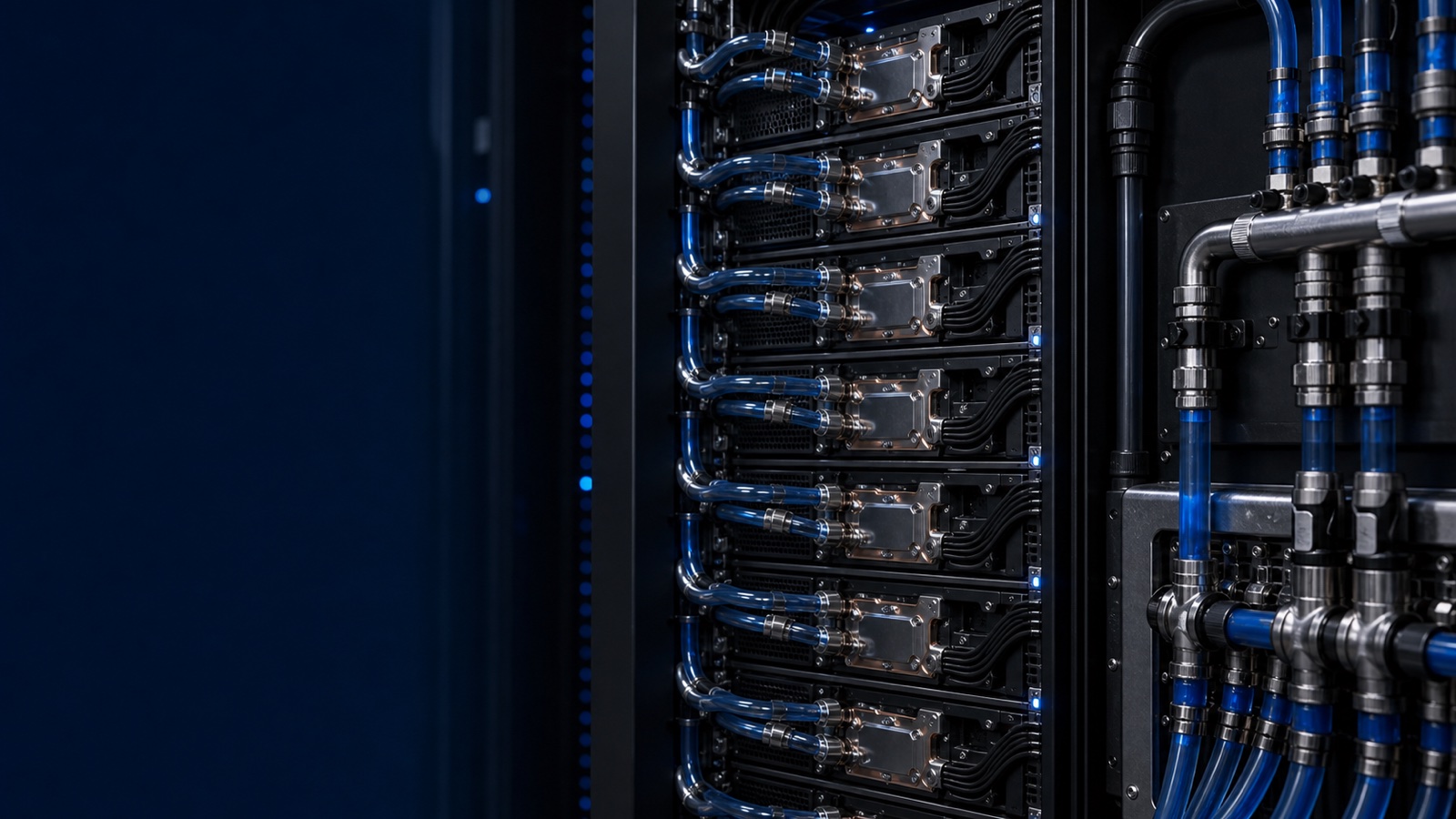
The thermal math for modern AI has become unforgiving. A single NVIDIA H100 SXM GPU dissipates up to 700 watts, and a Blackwell-class accelerator pushes higher still. Pack eight GPUs into one server, then fill a rack, and you cross power densities that conventional computer-room air conditioning was never designed to handle. Liquid cooling for AI data centers has moved from an exotic option reserved for national labs to a baseline expectation for any serious AI build. This guide walks federal, DoD, SLED, healthcare, and enterprise buyers through the cooling approaches, the economics, and what Dell's portfolio offers today.
Why Air Cooling Hit a Ceiling
Traditional CRAC and CRAH units move chilled air across hot-aisle/cold-aisle rows at densities that peak around 15-25 kW per rack. Rear-door heat exchangers can stretch that toward 30-40 kW. Modern AI accelerators blow past those limits. The root issue is physics: water carries far more heat per unit volume than air. Once a rack exceeds roughly 40 kW, air cooling either fails or demands floor space, airflow, and chiller capacity that become prohibitively expensive. Cooling can already account for 30-40% of a data center's total electricity draw, and that fraction climbs for dense AI unless liquid enters the thermal path.
The Three Dominant Approaches
Direct-to-chip (direct liquid cooling, or DLC). Cold plates sit directly on CPUs and GPUs, plumbed into a recirculating loop. Heat is extracted at the source and handed to a facility water loop through a coolant distribution unit (CDU). Lower-heat components such as DIMMs and SSDs may stay air-cooled. DLC is the most widely deployed approach in enterprise AI clusters and the one Dell builds across its PowerEdge AI line.
Rear-door heat exchangers (RDHx). A liquid-cooled door replaces the rack's rear exhaust panel, cooling exhaust air before it leaves the rack. RDHx is a useful retrofit for moderate-density racks (30-60 kW) and needs less plumbing than full DLC, but it cannot match DLC efficiency at extreme densities.
Immersion cooling. Servers are submerged in a dielectric fluid, either single-phase or two-phase. Immersion achieves the highest density but requires custom hardware, specialized fluids, and longer maintenance windows, making it best suited to ultra-dense, standardized pods rather than general enterprise fleets.
| Approach | Typical rack density | Facility water | Best fit |
|---|---|---|---|
| Air cooling (baseline) | Up to ~25 kW | No | Light compute, edge |
| Rear-door heat exchanger | 30-60 kW | Yes | Moderate AI inference, retrofit |
| Direct liquid cooling | 50-480 kW | Yes | AI training, rack-scale |
| Immersion | 100 kW+ | Yes | Ultra-dense pods, research |
Dell's Liquid Cooling Portfolio
Dell PowerEdge XE9680 and XE9680L. The XE9680 is Dell's flagship 8-GPU AI server, supporting NVIDIA H100/H200 SXM accelerators. The XE9680L is the direct-liquid-cooled variant, placing cold plates on the GPUs and CPUs so the bulk of server heat is carried by the liquid loop rather than dumped into the room. It is the workhorse for enterprise training and fine-tuning where a facility water loop and CDU are available.
Dell PowerEdge XE9712 with NVIDIA GB200/GB300 NVL72. For rack-scale generative AI, the XE9712 brings NVIDIA's NVL72 architecture into Dell's Integrated Rack, connecting Grace CPUs and Blackwell GPUs in a single liquid-cooled domain designed for the largest training and inference jobs.
Dell Integrated Rack 7000 (IR7000). Built on Open Compute Project standards, the IR7000 is a 21-inch rack engineered for liquid cooling from the ground up. It supports DLC deployments up to 480 kW per rack and captures nearly 100% of the heat generated, so almost nothing is exhausted into the data center.
Dell PowerCool coolant distribution units. Dell's PowerCool rack-mount CDU delivers up to roughly 160 kW of cooling per unit, enough to support extreme-density configurations such as NVIDIA GB300 NVL72 or fully populated GPU racks. The CDU circulates a closed secondary loop to the cold plates and transfers captured heat to the facility loop through a liquid-to-liquid exchanger, so building water never touches server components.
Dell PowerEdge R660 and R760 with DLC. For teams scaling into AI incrementally, the 1U R660 and 2U R760 both offer direct-liquid-cooling modules alongside Dell's Smart Flow chassis. These let buyers introduce DLC at the server level without committing to a full rack-scale overhaul. All of these platforms surface coolant and component health through iDRAC, Dell's embedded management controller. For organizations that prefer to consume this as a service rather than buy outright, Dell APEX offers AI infrastructure on a subscription basis.
Facility Requirements Buyers Underestimate
The technology inside the server is only half the equation. DLC requires a building-side chilled or warm water supply, and CDUs actively hold the secondary loop above the room's dew point to prevent condensation, so accurate environmental data matters. Routing supply and return lines to each rack row demands coordination with facilities, structural engineering, and leak-detection planning; those lead times can dwarf server delivery. Water chemistry must meet Dell's specifications, since untreated tap water causes corrosion and scaling that degrade heat transfer over time. Federal and healthcare buyers should engage facilities teams early, sometimes 12-18 months ahead, to assess pipe routing, floor loading, and building-management compatibility.
The Economics
Liquid cooling carries a higher capital cost than air, but TCO reframes the picture. Air-cooled AI data centers commonly run a PUE of 1.4-1.6; well-implemented DLC can reach 1.05-1.15, cutting continuous power draw substantially at scale. Liquid also enables far higher rack densities, shrinking floor space and build-out cost, while lower, steadier operating temperatures extend component life. At densities above 50 kW per rack, energy savings alone typically drive payback within a few years. Closed-loop DLC that uses no evaporative water also improves Water Usage Effectiveness, which directly helps federal and SLED buyers meet energy and sustainability reporting mandates.
How Uniqcli Helps
Uniqcli is an authorized Dell Technologies partner supporting federal, DoD, SLED, healthcare, and enterprise buyers through AI infrastructure procurement. We help scope the right cooling approach, match it to the appropriate Dell platform, and coordinate the facility planning DLC requires. Dell hardware is available to public-sector buyers, quoted by RFQ, with TAA-compliant configurations for agencies that require them. Whether you are evaluating options or ready to specify a build, request a quote or contact our team to start the conversation.