
PowerEdge Rack, Tower, or Modular: Choosing the Right Server Form Factor
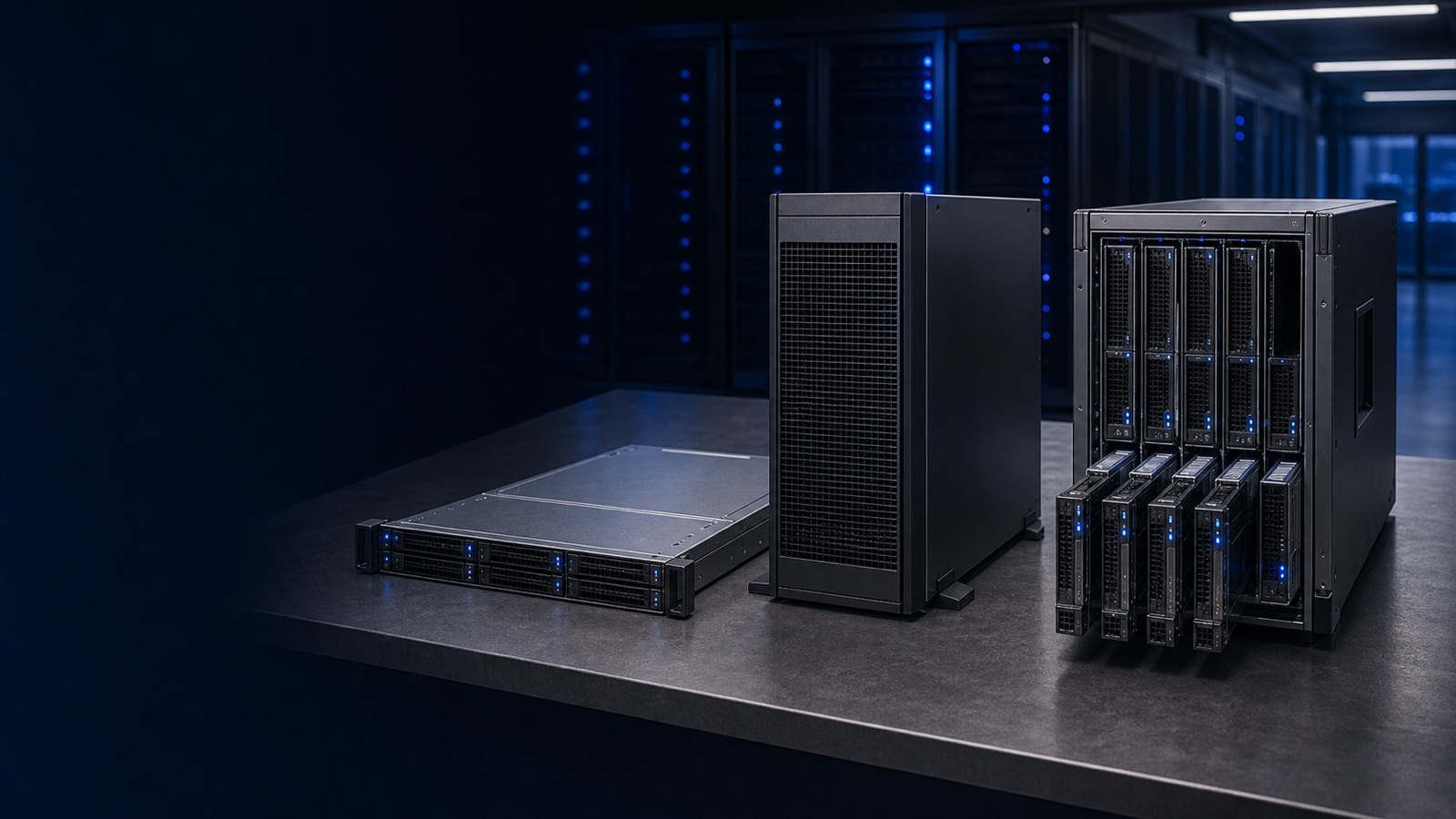
Form factor is the first real architectural decision in any PowerEdge deployment, and it is one of the few you cannot cheaply reverse. Processor, memory, and storage configurations can be tuned at order time or upgraded later. But the choice between rack, tower, and modular shapes your power envelope, your cabling, your cooling strategy, and how you scale for the next refresh cycle. Get it right and the platform fades into the background. Get it wrong and you are paying for rack units you cannot cool or stranded capacity you will never fill.
This guide frames the decision around three variables that actually drive it: the site where the hardware lives, the density you need per rack, and the scale you expect to reach. The Dell PowerEdge line maps cleanly onto those variables once you stop thinking in SKUs and start thinking in deployment patterns.
R-Series Rack: The Default for the Data Center
For most centralized IT, a rack server is the right answer, and the PowerEdge R-series is the workhorse. A 1U R660 or 2U R760 slots into standard 19-inch racks, stacks vertically for density, and feeds cleanly into hot-aisle/cold-aisle containment. If you operate a data center, a colocation cage, or a consolidated agency facility, this is your baseline.
Choose rack when:
- You have a controlled facility with proper cooling, raised floor or containment, and redundant power feeds.
- You are scaling horizontally — virtualization clusters, container hosts, VDI, or database tiers that grow node by node.
- You want broad serviceability. Rack servers are the most common form factor, so spares, rails, PDUs, and trained hands are everywhere.
The R660 suits compute-dense, memory-balanced roles where 1U is enough. The R760 gives you the expansion room — more drive bays, more PCIe slots for GPUs or high-speed NICs, and headroom for accelerated workloads. Both pair naturally with Dell storage: PowerStore for unified block and file, PowerScale for scale-out file and unstructured data, PowerMax for tier-zero mission-critical arrays, and PowerProtect for backup and cyber-recovery. For AI and analytics, the rack tier is also where you land GPU-heavy PowerEdge platforms.
Every R-series ships with iDRAC for out-of-band management and integrates with OpenManage for fleet-wide monitoring, firmware baselining, and lifecycle automation — essential when you are managing dozens or hundreds of nodes against a hardening standard.
T-Series Tower: Edge, Branch, and the Quiet Office
A tower server is not a lesser rack server. It is a different tool for a different site. The PowerEdge T-series is built for places that have no rack, no raised floor, and often no dedicated server room — branch offices, clinics, schools, field sites, manufacturing floors, and small agency outposts.
Choose tower when:
- The hardware lives in an office, closet, or shop floor rather than a data center.
- You have one to a few servers per location, not a row of them.
- Acoustics, ambient-temperature tolerance, and a self-contained chassis matter more than rack density.
Towers draw standard wall power, tolerate warmer and dustier environments than a packed rack, and run quieter at the desk-side. For a SLED district standing up a server in a wiring closet, or a healthcare practice running a local imaging or EHR cache, a tower is frequently the correct and lower-friction answer. You still get iDRAC and OpenManage, so a tower at a remote site is just as remotely manageable as anything in the core — important when you have no on-site IT staff. Many towers can also be rail-converted to rack mounting later, giving you a migration path if a branch eventually consolidates.
MX Modular: Composable Infrastructure at Scale
The PowerEdge MX platform is a modular, composable chassis — compute sleds, storage sleds, and shared fabric in a single 7U enclosure with a disaggregated, software-defined backplane. It is not a replacement for rack servers in every deployment; it is a deliberate choice for organizations standardizing a large, long-lived private cloud or consolidation program.
Consider modular when:
- You are running a large virtualization or private-cloud estate and want to compose compute and storage resources rather than rack discrete nodes.
- You want a single management plane (OpenManage Enterprise with the chassis management module) across many sleds, reducing per-node cabling and touch.
- You are planning multi-generation refreshes and want a fabric architecture that absorbs new sled generations without re-cabling the rack.
MX shines in density and lifecycle economics at scale, but it carries more upfront design commitment and a higher floor on quantity. For a handful of servers, it is overkill. For a multi-hundred-node consolidation with a five-to-seven-year horizon, it can dramatically cut cabling, power distribution complexity, and operational overhead.
A Quick Decision Framework
Run the choice through three questions in order:
- Where does it live? No data center and only a few units per site, choose tower. Controlled facility, choose rack or modular.
- How dense and how many? A row of nodes scaling horizontally, choose rack. A large standardized estate composing resources under one fabric, evaluate MX modular.
- What is the refresh horizon? Short or uncertain, stay with rack for flexibility and ubiquitous spares. Long, large, and standardized, modular's lifecycle economics start to win.
Federal and public-sector buyers have one more layer: procurement and compliance. PowerEdge configurations are available to federal, DoD, and SLED buyers and can be specified to meet TAA country-of-origin requirements, FIPS 140-3 validated cryptography for relevant components, and NIST 800-171 controls for systems handling controlled unclassified information. Form factor and compliance are independent decisions, so you can optimize the architecture without compromising the acquisition path.
The Takeaway
Match the form factor to the site, the density, and the scale — in that order. Rack for the data center default, tower for edge and branch sites without a rack, modular for large standardized estates with a long horizon. Most organizations end up with a mix, and that is exactly right.
If you want a second set of eyes on the trade-offs — including configuration, compliance, and the cleanest procurement path for your program — request a quote or talk to a Uniqcli specialist. We will help you spec a PowerEdge platform that fits your site and your contract.