
Securing IoT Devices with Network Access Control
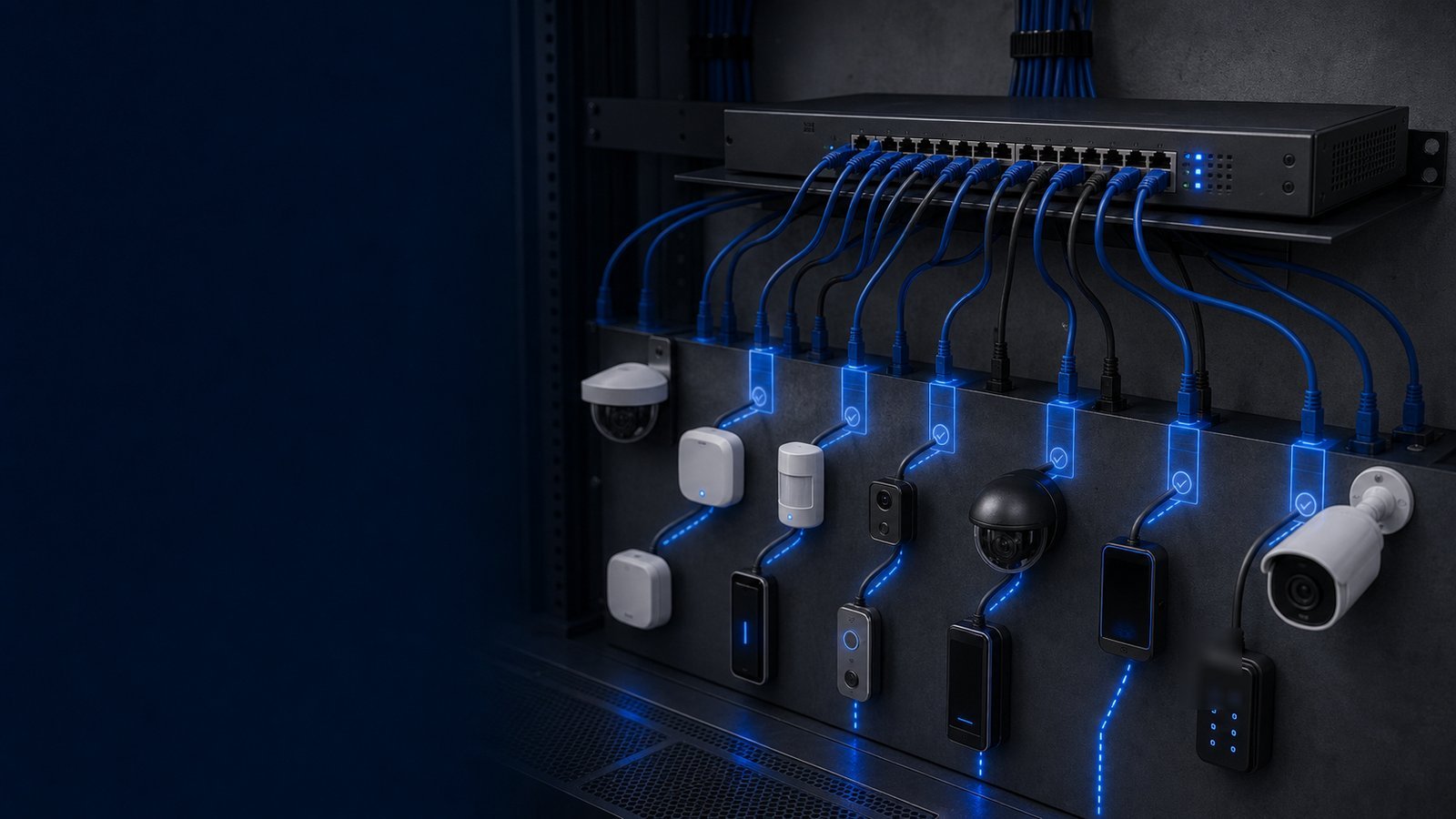
The proliferation of connected devices has fundamentally changed what "the network" means. In hospitals, a single floor may host infusion pumps, patient monitoring systems, smart HVAC controllers, and badge readers—all sharing the same physical infrastructure as clinical workstations. In federal agencies and SLED environments, building automation systems, IP cameras, and environmental sensors increasingly sit alongside classified workloads. Across the enterprise broadly, IoT Analytics estimated more than 21 billion connected IoT devices globally by the end of 2025, with industrial and commercial deployments leading growth. Most of those devices were never designed with security in mind.
The result is a sprawling, heterogeneous attack surface that traditional perimeter defenses cannot address. Firewalls protect the edge, but offer little when a compromised medical infusion pump begins scanning internally. IoT security NAC—Network Access Control applied specifically to connected device environments—is now the foundational control that bridges the gap between visibility and enforcement. This post explains why NAC matters for IoT, how it works in practice, and how Dell Networking Zero Trust provides a proven, policy-driven answer.
Why IoT Devices Create a Distinct Security Problem
Standard IT endpoints—laptops, workstations, phones—can run security agents, accept certificate-based authentication, and report compliance posture. IoT devices typically cannot. The average Internet of Medical Things (IoMT) device carries 6.2 known vulnerabilities, and 60% of connected medical devices run firmware that no longer receives security updates. The situation is similar in industrial and building-automation contexts.
Several characteristics make IoT uniquely difficult to secure:
- No agent support. Most IoT devices run embedded operating systems that cannot host endpoint detection, posture-assessment, or 802.1X supplicant software.
- Default or shared credentials. Manufacturers often ship devices with well-known default passwords that never get changed at deployment.
- Long operational lifespans. A hospital ventilator or industrial PLC may remain in service for 10–15 years, far outliving vendor patch support.
- Flat network exposure. Without segmentation, a single compromised sensor can reach critical databases, EHR systems, or operational technology (OT) control systems via lateral movement.
- High device density. A single campus may add hundreds of new IoT endpoints in a week—far too many for manual per-device policy configuration.
The 2024 Change Healthcare breach—exposing protected health information for more than 150 million individuals—underscored how quickly attackers can move laterally once inside a healthcare network. Meanwhile, the HHS December 2024 proposed updates to the HIPAA Security Rule eliminated the "addressable" classification for network segmentation, making it a mandatory control for covered entities.
What Network Access Control Does—and Does Not Do
Network Access Control (NAC) is a security discipline that authenticates and authorizes endpoints before and after they join the network, then enforces policy continuously. It is not a next-generation firewall, not an IDS/IPS, and not a replacement for endpoint protection. NAC is the enforcement layer that ensures every device connecting to your infrastructure is known, classified, and constrained to only the resources it legitimately needs.
NAC operates in two phases:
- Pre-admission: Before a device is granted network access, NAC checks its identity (who/what is this device?), its health posture (does it meet compliance requirements?), and its context (where is it connecting from, at what time, over which port?). Based on policy, the device is either permitted, quarantined, or denied.
- Post-admission: After initial access, NAC continues to monitor device behavior. If a profiled medical device starts making anomalous DNS requests or attempts lateral connections to IT segments, policy can dynamically revoke or restrict access—often without human intervention.
For IoT, the pre-admission phase is particularly important because most devices cannot self-attest their health. NAC must rely on passive profiling to identify what a device is before applying the appropriate policy.
How Zero Trust Policy Manager Secures IoT Endpoints
Dell Networking Zero Trust Policy Manager is a purpose-built NAC platform designed for multivendor, heterogeneous environments. It handles authentication, authorization, and accounting (AAA) via RADIUS and TACACS+, and enforces policy across wired, wireless, and VPN infrastructure regardless of the underlying switch or access point vendor.
For IoT specifically, Zero Trust provides several mechanisms that work around the limitations of headless, agent-free devices:
- MAC Authentication Bypass (MAB). For devices that cannot run 802.1X supplicants—which covers the vast majority of IoT hardware—Zero Trust uses the device's MAC address as a credential. MAB is paired with profiling so that the MAC address alone does not grant broad access; the device type informs which VLAN and role it receives.
- DHCP fingerprinting. Zero Trust examines DHCP request options (option 55, 60, and others) to identify the device OS and class without requiring any software on the device itself.
- TCP fingerprinting and behavioral analysis. Passive analysis of packet characteristics further refines device classification.
- OnConnect enforcement. For wired environments where 802.1X is not available on the switch, Zero Trust can enforce policy using SNMP-based port control via its OnConnect feature, extending NAC coverage to legacy switching infrastructure.
- Context-based policy engine. Policies can incorporate user identity, device type, time of day, location, and posture simultaneously, enabling fine-grained role assignment rather than binary allow/deny decisions.
Zero Trust Device Insight: AI-Powered Discovery for the Unknown Device Problem
The hardest part of IoT security is not enforcing policy—it is knowing what to enforce policy against. Organizations routinely have shadow IoT devices that were never inventoried: a facilities team plugging in a smart thermostat, a nurse bringing in a personal glucose monitor, a contractor leaving a network-connected sensor running after a project ends.
Zero Trust Device Insight is a cloud-hosted, machine learning-driven discovery and profiling engine that complements Zero Trust Policy Manager. It uses:
- Active and passive discovery across wired and wireless segments simultaneously.
- Deep packet inspection (DPI) to classify application traffic without decryption.
- ML-assisted fingerprinting trained on a large, crowdsourced device library to identify device makes, models, and operating systems—including obscure OT and medical hardware—with high confidence.
- Behavioral analysis to flag devices whose traffic patterns deviate from their classified baseline, which can indicate compromise or misconfiguration.
The result is a continuously updated, real-time inventory of every IP-enabled device on the network. That inventory feeds directly into Zero Trust Policy Manager, enabling automatic policy assignment as new devices are profiled—without requiring manual intervention for each new endpoint.
Network Segmentation and Dynamic Policy Enforcement
Visibility alone is not sufficient. The second pillar of IoT security NAC is micro-segmentation—placing devices in network segments that are isolated from resources they have no legitimate reason to reach.
Zero Trust enforces segmentation dynamically using role-based access control (RBAC). When a device is authenticated and profiled, Zero Trust assigns it a role, which maps to a VLAN or a set of firewall rules applied at the network edge. The segmentation model typically includes:
- IoT/OT segment: Devices with no user interaction; tightly restricted egress; typically no internet access.
- Medical device segment (for healthcare): Aligned with HIPAA-required controls; isolated from general IT workloads.
- Guest/contractor segment: Internet access only; no internal resource reachability.
- Corporate device segment: Full access to resources commensurate with user role and device compliance.
When integrated with Dell Networking CX switches and Dell wireless access points, Zero Trust can push dynamic VLAN assignments and downloadable ACLs (DACLs) in real time. A device that initially connects as "unknown" is placed in a quarantine VLAN until profiling completes; once classified, it is moved to the correct segment automatically. If a device's behavior later deviates from its profile, Zero Trust can trigger a CoA (Change of Authorization) to move it to a restricted segment without requiring a manual re-authentication cycle.
Comparing NAC Approaches for IoT Environments
Not all NAC approaches deliver the same capability for IoT-heavy environments. The table below compares the primary strategies organizations use.
| Approach | IoT Agent Support | Passive Profiling | Dynamic Segmentation | Multivendor Support | Typical Use Case |
|---|---|---|---|---|---|
| 802.1X with supplicant | No (most IoT lacks it) | Partial | Yes | Yes | Managed laptops, phones |
| MAC Auth Bypass (MAB) only | Yes | No | Limited | Yes | Basic IoT onboarding |
| MAB + Passive Profiling (Zero Trust) | Yes | Yes (DHCP, TCP, DPI) | Yes | Yes | Enterprise/healthcare/SLED IoT |
| AI-Assisted Profiling (Device Insight) | Yes | Yes (ML + behavioral) | Yes (auto role assignment) | Yes | Large-scale, dynamic IoT fleets |
| Manual VLAN assignment | Yes | No | No | Yes | Small static environments only |
For any environment with more than a few dozen IoT endpoints—and certainly for federal, healthcare, or large enterprise deployments—manual approaches quickly become unmanageable. The combination of Zero Trust Policy Manager and Device Insight represents the mature, scalable tier.
Zero Trust and Regulatory Alignment
Zero trust is not a product; it is an architectural philosophy stating that no device or user should be trusted by default, regardless of network location. NAC is a core zero trust enforcement mechanism: it establishes verified device identity, enforces least-privilege access, and enables continuous monitoring.
Zero Trust aligns directly with several regulatory and compliance frameworks relevant to Uniqcli's customer base:
- HIPAA (2025 updates): The December 2024 HHS proposed rule makes network segmentation a mandatory requirement. Zero Trust's dynamic VLAN enforcement satisfies this control, and Device Insight provides the inventory documentation required for audit.
- NIST SP 800-213 (IoT Device Cybersecurity): Calls for device identification, configuration management, and event logging—all capabilities native to Zero Trust.
- CMMC / FedRAMP environments: NAC contributes to access control (AC), configuration management (CM), and audit/accountability (AU) domains. Zero Trust's RADIUS logs and role-assignment events provide audit trails that align with these control families.
- SLED / state regulations: Many state agencies have adopted frameworks mirroring NIST CSF or CIS Controls, both of which include network access control as a foundational safeguard.
Organizations pursuing request for quote conversations with Uniqcli for network security upgrades frequently need to document how their NAC deployment maps to these controls—something Zero Trust is architected to support from day one.
Implementation Considerations: Where to Start
Deploying NAC in an IoT-heavy environment does not have to be a rip-and-replace project. A phased approach reduces risk and accelerates time-to-value:
Phase 1 — Discover and inventory. Deploy Zero Trust Device Insight in passive-only mode. Allow it to enumerate and classify every device on the network. This produces the asset inventory many organizations lack and identifies shadow IoT devices before enforcement begins. Expect 2–4 weeks for a campus-scale deployment to build a comprehensive baseline.
Phase 2 — Authenticate without enforcing. Configure Zero Trust Policy Manager in monitor mode alongside MAB. Verify that device classifications are accurate and that policy roles map correctly to device types before any enforcement action is taken.
Phase 3 — Enforce segmentation on known IoT segments. Begin by enforcing VLAN assignment for well-understood device categories—IP cameras, printers, environmental sensors. These have predictable traffic patterns and low operational risk from a policy mistake.
Phase 4 — Expand to full enforcement. Roll out dynamic role assignment across all device categories. Enable CoA responses for behavioral anomalies. Integrate with SIEM for centralized event correlation.
This phased approach is described in detail in our network access control implementation guide, which covers infrastructure prerequisites, Dell switch configuration, and licensing considerations.
Licensing and Platform Options
Zero Trust is available in several configurations aligned to deployment scale:
- Zero Trust Policy Manager handles AAA, enforcement, and guest/onboarding workflows. It is licensed per endpoint and available as a virtual appliance or hardware appliance (C1000V, C3000V, and physical appliances for large-scale deployments).
- Zero Trust Device Insight adds the cloud-based ML profiling engine. It is licensed separately and integrates directly into the Policy Manager interface.
- Zero Trust OnGuard extends posture assessment to endpoints that can run agents, useful in hybrid environments with both managed laptops and IoT devices.
Uniqcli works with Dell Networking as an authorized partner and can structure licensing to match your endpoint count, deployment model, and budget cycle. For federal and SLED customers, we are experienced with the compliant procurement paths that can simplify buying. Visit our Dell Networking product pages for detailed specifications or browse available configurations.
How Uniqcli Helps
Securing IoT devices is not a product purchase—it is a deployment and architecture decision that depends on your existing infrastructure, your regulatory obligations, and the device types you need to control. Uniqcli's team has hands-on experience deploying Zero Trust Policy Manager and Device Insight in federal, SLED, healthcare, and enterprise environments. We help you scope the right licensing tier, design the segmentation model, and validate compliance alignment before you go live.
Whether you are starting from scratch with a first NAC deployment or extending an existing Zero Trust installation to cover a new IoT segment, we can help you move from unmanaged device sprawl to a fully auditable, zero trust-aligned network access posture.
Contact our team for a no-obligation consultation, or request a quote for Zero Trust licensing and professional services scoped to your environment.