
Data Center Switching: Dell PowerSwitch 8325 vs 9300
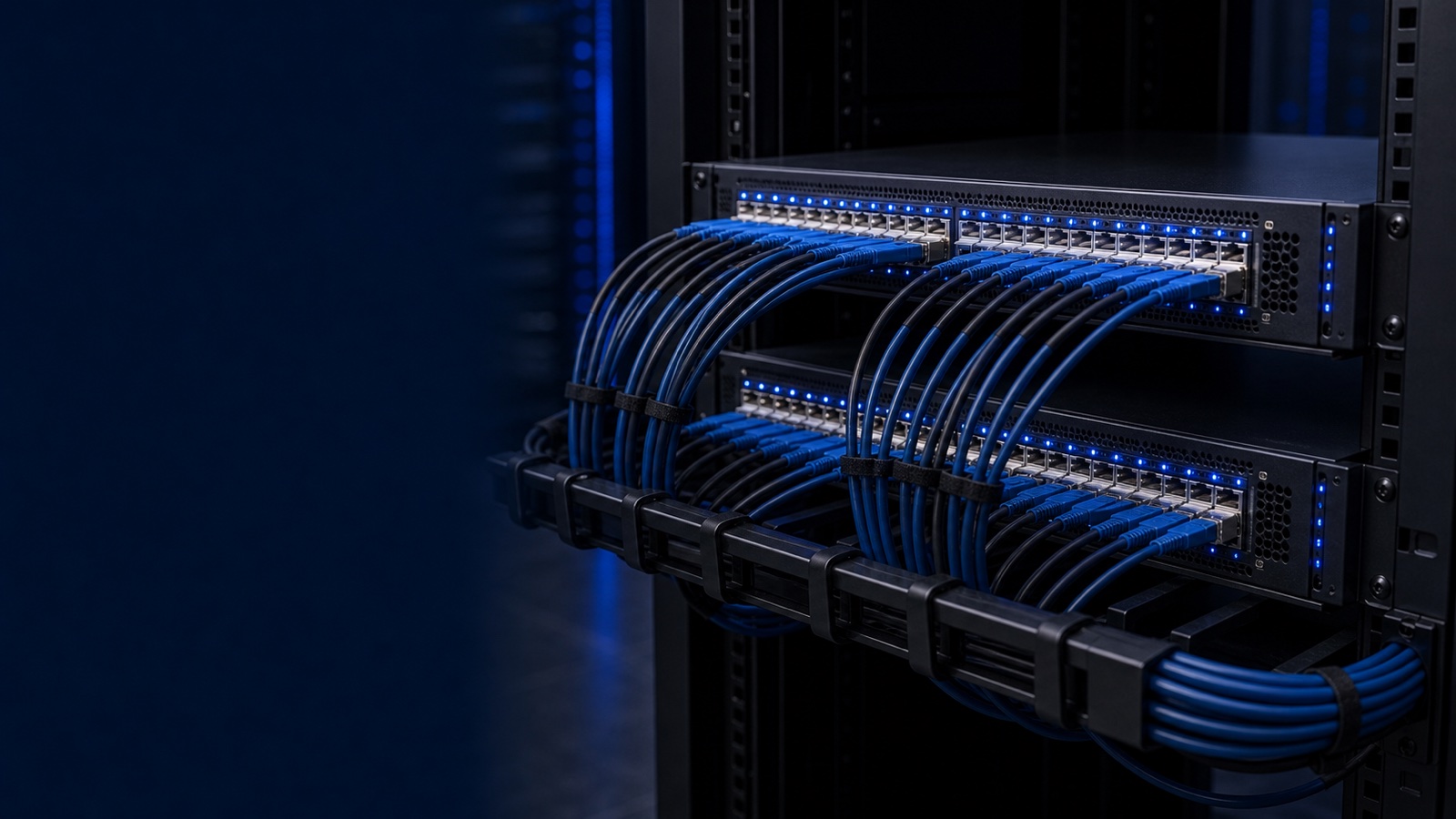
The data center switching market has bifurcated around a clear architectural question: are you building a high-density 100GbE leaf-spine fabric today, or are you laying groundwork for 400GbE scale tomorrow? Dell Networking's CX 8325 and CX 9300 series sit on either side of that divide — and understanding where each platform excels will determine whether your next switching investment serves you for three years or ten. Both run the same AOS-CX operating system, both drop into a 1U rack slot, and both support EVPN-VXLAN overlays with full BGP routing stacks. The differences come down to silicon generation, port density, and the scale of workloads each platform was designed to carry.
This post breaks down the dell 8325 vs 9300 decision in detail: hardware specs, software capabilities, form factor, target deployment roles, and the specific buyer profiles where each platform makes the most sense. If you are evaluating these platforms for a federal agency, healthcare network, SLED campus core, or enterprise data center refresh, read on.
Hardware Architecture and Switching Capacity
The CX 8325 and CX 9300 are built on different silicon generations, and the performance gap is substantial.
The Dell PowerSwitch 8325 delivers 6.4 Tbps of switching capacity with 4,800 Mpps of forwarding in a 1U chassis. It is a fixed-configuration platform available in two primary configurations:
- CX 8325-32C — 32 ports of 100G QSFP+/QSFP28
- CX 8325-48Y8C — 48 ports of 1/10/25G SFP/SFP+/SFP28 plus 8 ports of 40/100G QSFP+/QSFP28
The Dell PowerSwitch 9300 is a different league entirely. The flagship CX 9300-32D provides 25.6 Tbps of switching capacity — a 4x increase over the 8325 — with 32 ports of QSFP-DD supporting 100G, 200G, or 400G per port, plus 2 ports of 10G SFP+ for out-of-band management. Each 400G port can be broken out as 4x100G, 2x200G, or 1x400G, giving the platform exceptional density flexibility. The CX 9300S variant delivers 32 ports of 100G QSFP28 plus 8 ports of 400G QSFP-DD — a hybrid approach that bridges high-density 100GbE leaf connectivity with 400GbE spine uplinks in a single 1U unit.
| Specification | CX 8325-32C | CX 8325-48Y8C | CX 9300-32D | CX 9300S |
|---|---|---|---|---|
| Switching Capacity | 6.4 Tbps | 6.4 Tbps | 25.6 Tbps | 16 Tbps |
| High-Density Ports | 32x 100G | 48x 25G + 8x 100G | 32x 400G (QSFP-DD) | 32x 100G + 8x 400G |
| Breakout Support | Yes (4x25G) | Yes | Yes (4x100G, 2x200G) | Yes |
| Form Factor | 1U | 1U | 1U | 1U |
| Max PSU | 2 | 2 | 2 | 2 |
| Hot-Swap Fans | 6 | 6 | 6 | 6 |
| OS | AOS-CX | AOS-CX | AOS-CX | AOS-CX |
Software Feature Parity: What Both Platforms Share
One of the clearest advantages of the Dell PowerSwitch product line is that AOS-CX delivers a consistent feature set across generations. Both the 8325 and 9300 support:
- BGP, OSPF, IS-IS, and VRF-Lite for full L3 routing with multi-tenancy
- Dynamic EVPN-VXLAN with BGP control plane for data center overlay networking
- VSX (Virtual Switching Extension) for active-active redundancy without spanning tree
- Network Analytics Engine (NAE) for streaming telemetry, health monitoring, and automated troubleshooting scripts
- REST API and OpenConfig for programmable management and DevOps-style automation pipelines
- FIPS 140-2 validated cryptography for protection of sensitive government traffic
This means your team builds skills and automation scripts on one OS that transfers across both platforms. If you already run CX 8325 switches today, your network engineers can operate CX 9300 hardware without retraining on a new CLI or management paradigm.
For organizations browsing Dell PowerSwitch switch options, this platform consistency is a significant long-term operational advantage.
Leaf-Spine Roles: Where Each Switch Belongs
Understanding the intended role of each platform in a leaf-spine topology is the fastest way to make the right buying decision.
CX 8325 as a leaf switch: The 8325 is a purpose-built top-of-rack (ToR) and campus core leaf switch. In a dual-ToR configuration, a pair of CX 8325-48Y8C switches can serve a single compute rack with redundant 25GbE server connections, using 100G uplinks to spine switches. A single CX 8325-32C deployed as a leaf can support up to 700 x 25GbE servers at full fabric scale — appropriate for small to mid-size data center pods and campus core deployments.
CX 9300 as spine and high-density leaf: The 9300 is designed for spine roles and ultra-high-density leaf deployments. As a spine switch, the CX 9300-32D can aggregate 128 x 100GbE connections (using 4x100G breakout on each 400G port) or 64 x 200GbE connections — enough to serve large enterprise or cloud-scale data center pods. Dell has validated the CX 9300 in fabric topologies supporting up to 6,000 x 25GbE servers or 2,000 x 100GbE servers in a single pod, representing an 8x scaling advantage over CX 8325 spine topologies.
The 9300 can also serve as a high-performance leaf for compute environments where GPU clusters or NVMe-over-Fabrics storage arrays need 100G or 200G server-facing ports and 400G uplinks to spine in the same 1U device.
Target Workloads: Use Case Mapping
Neither platform is universally "better" — the right choice depends on what you are running in the data center.
CX 8325 is the right choice when:
- Server-facing connections are 1G, 10G, or 25G (the 48Y8C model handles all three)
- You need a campus core switch capable of dual-homing access layer switches via VSX
- Budget is a primary constraint and 100GbE spine capacity is sufficient for current and near-term workloads
- You are refreshing legacy campus distribution or small colocation environments
- Your environment benefits from the half-width CX 8325H variants (2.16 Tbps or 4 Tbps) for space-constrained deployments
CX 9300 is the right choice when:
- Your spine tier must handle 400GbE inter-switch links or uplinks to a WAN or DCI circuit
- You are building fabric to support AI/ML GPU cluster workloads requiring high-bandwidth, low-latency RoCEv2 over Ethernet
- Your data center pod design needs to scale beyond 1,000 servers without adding additional spine tiers
- You are deploying NVMe-oF storage fabrics where 100G or 200G host connections are needed at the leaf layer with 400G uplink capacity
- Your organization has a multi-year runway and wants switching silicon that will remain current through the next server generation refresh
Federal, SLED, and Healthcare Compliance Posture
Both platforms carry certifications relevant to regulated buyers, but there are nuances to understand.
The CX 8325 has a well-established compliance posture with multiple years of validation:
- TAA-compliant configurations available
- DoDIN APL listed (Department of Defense Information Network Approved Products List)
- NDcPP (Network Device collaborative Protection Profile) certification
- FIPS 140-2 validated cryptographic modules
- USGv6 compliance for IPv6 deployment in federal networks
The CX 9300 runs the same AOS-CX software stack with the same cryptographic libraries. Federal buyers evaluating the 9300 for spine roles should verify current DoDIN APL status with their Dell Networking representative, as newer platforms proceed through the validation cycle after initial product release. For federal RFPs requiring confirmed APL listing today, the CX 8325 is the safer documented choice pending updated 9300 validation records.
Healthcare organizations subject to HIPAA should note that both platforms support VRF-based micro-segmentation and encrypted management plane traffic — key requirements for isolating clinical networks from administrative and guest infrastructure. SLED buyers pursuing E-Rate or BEAD funding for campus network modernization will find the CX 8325 better aligned with current ToR and core switching use cases at typical SLED scale. Need help confirming compliance status for a specific procurement? Contact our team for a vendor-backed compliance review.
Resiliency and High Availability Features
Both platforms share the same resiliency architecture, which is a meaningful operational advantage over competing platforms that differentiate HA features by product tier.
VSX (Virtual Switching Extension) provides active-active L2 and L3 redundancy between two switches, eliminating spanning tree from the forwarding path while maintaining a simple two-unit redundancy model. VSX allows each switch to independently forward traffic while appearing as a single logical device to connected servers and access switches — no chassis dependency, no single point of failure.
Hot-swappable, field-replaceable power supplies and fans are standard on both the 8325 and 9300 series. Each platform supports two PSUs in redundant configuration and six fans with N+1 coverage. For government and healthcare data centers with strict uptime SLA requirements, this matters: you can replace a failed power supply during business hours without a maintenance window.
The AOS-CX In-Service Software Upgrade (ISSU) capability available on supported configurations allows software updates to be applied without dropping forwarding — a critical feature for 24/7 healthcare and federal environments where change windows are scarce.
Network Analytics and Observability
Both platforms include the Network Analytics Engine (NAE) natively, which distinguishes Dell PowerSwitch from competitors where telemetry and analytics require separate licensing or appliances.
NAE provides:
- Streaming telemetry via gNMI/gRPC for integration with Grafana, Splunk, or Dell Networking Central
- Pre-built monitoring scripts for common conditions like BGP session state, VSX sync health, CPU/memory thresholds, and interface error rates
- Custom Python-based agents that can execute automated remediation actions when conditions are met
- Historical data logging on-box for post-incident analysis without requiring external collection infrastructure
For teams moving toward network-as-code workflows, both the 8325 and 9300 expose full REST API and support OpenConfig models, making them compatible with Ansible, Terraform, and custom CI/CD pipelines. Organizations looking to standardize automation across their switching estate can explore Dell's published AOS-CX automation resources or connect with Uniqcli's pre-sales team via the networking products page to discuss validated design patterns.
Total Cost of Ownership Considerations
List price is only one dimension of TCO for enterprise switching. Several factors favor the CX platform broadly:
- Single OS across the portfolio reduces training costs and operational complexity as you mix 8325 and 9300 switches in the same fabric
- Integrated analytics eliminates per-switch licensing fees common on competing platforms
- VSX active-active redundancy avoids the cost premium of chassis-based redundancy for most deployments
- Long software support lifecycle from Dell for AOS-CX means you are not forced into hardware refreshes by an end-of-software-support deadline
The CX 9300's higher upfront cost relative to the 8325 is offset by its ability to support significantly larger fabric pods without adding additional switches. A spine tier built on four CX 9300-32D switches can support a pod that would require substantially more CX 8325 units plus additional inter-switch cabling to achieve comparable scale.
For organizations managing capital budgets across fiscal years — particularly SLED agencies and healthcare systems with defined refresh cycles — Uniqcli can structure phased deployment plans that begin with CX 8325 leaf deployment and migrate spine to CX 9300 as bandwidth demands grow. Request a quote to see current Dell partner pricing.
How Uniqcli Helps
Choosing between the CX 8325 and CX 9300 is ultimately an architecture decision, not a spec sheet exercise. The right answer depends on your current server count, anticipated growth over the refresh cycle, workload mix (compute-heavy vs. storage-heavy vs. AI/ML), compliance requirements, and budget cadence.
As an authorized Dell Networking partner serving federal, SLED, healthcare, and enterprise buyers, Uniqcli provides:
- Architecture review to validate which platform fits your fabric design
- Compliance verification for TAA and DoDIN APL eligibility
- Competitive pricing through Dell authorized channels
- Phased deployment planning to align hardware acquisition with fiscal budget cycles
Whether you are building a new data center fabric from scratch or refreshing aging campus core infrastructure, our team can help you avoid costly over-specification or under-sizing mistakes. Contact us to start a conversation, or request a quote directly with your requirements — we'll respond with pricing, availability, and recommended configurations within one business day.