
Dell Networking vs Dell PowerSwitch: SMB vs Enterprise Networking
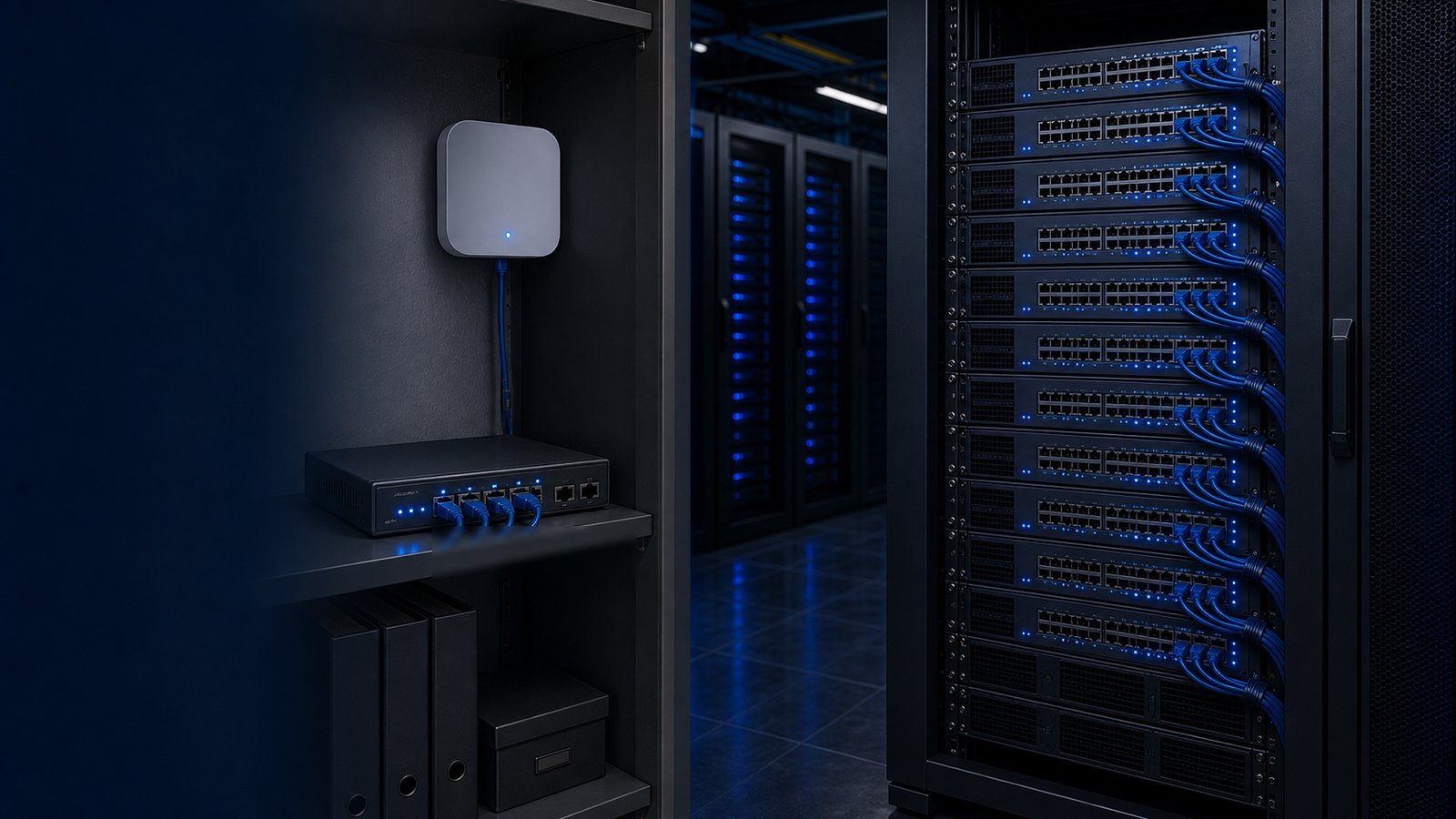
If you are shopping for Dell Networking networking gear, one of the first decisions you will face is whether to go with Dell Networking or the Dell PowerSwitch platform. Both carry the Dell name, both offer solid reliability, and both integrate with Dell's broader ecosystem — but they are built for fundamentally different buyers, environments, and IT maturity levels. Getting this choice wrong means either overspending on features you will never use, or painting yourself into a corner when you need to scale.
This guide breaks down the two platforms honestly, covering architecture, management, performance, security, licensing, and total cost of ownership so you can make the right call for your organization. Whether you run a 15-person professional services firm, a mid-size healthcare clinic, or a multi-site enterprise campus, the right answer is in the details.
What Each Platform Is Actually Built For
Dell Networking is Dell's purpose-built small-business networking line. It includes a series of unmanaged and smart-managed switches (the 1430, 1830, 1930, and 1960 series) along with Wi-Fi 6 and Wi-Fi 6E access points (AP21, AP22D, AP32, and others). The entire platform is designed around one premise: a non-technical business owner or office manager should be able to unbox the hardware, follow an app, and have a working network within an hour — with zero ongoing licensing fees.
Dell PowerSwitch is a fundamentally different animal. It is Dell Networking's enterprise switching platform, running the AOS-CX operating system — a modern, microservices-based network OS designed for programmability, automation, and high availability. The CX lineup spans from the CX 6000/6100 (branch and small office access) through the CX 6200 and CX 6300 (stackable campus access and aggregation) all the way up to the CX 8325 and CX 8400 (campus core and data center). It is managed through Dell SmartFabric Manager, a cloud or on-premises platform that requires subscription licensing.
The core distinction: Instant On trades depth for simplicity. CX trades simplicity for power.
Switch Lineup Compared Side by Side
The table below maps the two platforms across the most decision-relevant dimensions.
| Dimension | Dell Networking | Dell PowerSwitch |
|---|---|---|
| Target buyer | SMB, retail, branch, SOHO | Enterprise, mid-market, SLED, healthcare |
| Operating system | Instant On firmware | AOS-CX (modular, microservices-based) |
| Management | Instant On app / web portal (free) | Dell SmartFabric Manager (subscription required) |
| Licensing fees | None beyond hardware | Required (device + service tokens) |
| Layer 3 routing | Limited (1930/1960 offer basic L3) | Full L3: OSPF, BGP, VRF, policy routing |
| Stacking | 1960 series only (up to 4 units) | VSF up to 8 members (6200/6300); VSX HA pairs (6300/8x00) |
| High availability (VSX) | Not supported | Supported on CX 6300, 8325, 8400 |
| PoE budget | Up to 370W (1960 48-port PoE) | Up to 1,440W+ (CX 6300 series) |
| 10G uplinks | SFP+ on 1930/1960 | Native 10G/25G/100G across CX portfolio |
| Automation / APIs | None | REST API, NAE (Network Analytics Engine), Ansible, Terraform |
| Security features | WPA3, port security, ACLs (basic) | Dynamic Segmentation, 802.1X, RADIUS, TrustSec equivalents |
| Dell SmartFabric Manager integration | Partial (read-only visibility) | Full lifecycle management |
| Typical max network size | ~125 devices per site | Unlimited (enterprise scale) |
Management Experience: Simplicity vs. Control
The management gap between these two platforms is perhaps the starkest difference.
Dell Networking is managed through a free mobile app (iOS and Android) and a browser-based portal. Setup is genuinely plug-and-play: the app guides you through network creation, SSID configuration, and VLAN assignment in minutes. There are no licenses to buy, no agents to install, and no CLI required. A single Instant On account can manage up to 125 access points and switches across multiple sites. For a retail chain with locations staffed by non-IT personnel, this is a significant operational advantage.
Dell SmartFabric Manager — the management platform for CX switches and Dell enterprise APs — is a full-featured cloud network management system. It supports zero-touch provisioning, template-based configuration, AI-driven analytics, automated firmware upgrades, and granular role-based access control. It integrates with Dell's Network Analytics Engine (NAE) for real-time streaming telemetry and anomaly detection. It also supports an on-premises deployment (Dell SmartFabric Manager On-Premises) for organizations in air-gapped or data-sovereignty-sensitive environments like federal and classified SLED.
The trade-off is real: Dell SmartFabric Manager licensing adds per-device subscription cost, and the platform has a steeper learning curve. For organizations with a dedicated network engineer or MSP partnership, this is the right investment. For a 20-person dental office, it is overkill.
Performance and Scalability Ceilings
Dell Networking delivers solid, consistent Layer 2 performance for its target market:
- The 1430 series (unmanaged) handles basic connectivity at gigabit speeds with a fanless, quiet design — ideal for conference rooms and small offices.
- The 1930 series (smart-managed) offers 20 Gbps to 176 Gbps switching capacity with SFP+ 10G uplinks, handling most SMB workloads comfortably.
- The 1960 series (stackable smart-managed) pushes 128 Gbps to 320 Gbps switching capacity and 95 Mpps to 238 Mpps forwarding rate — serious throughput for a small-business-class platform.
Dell PowerSwitch operates at a completely different performance tier:
- The CX 6100 targets branch and entry-level campus access with reliable Gigabit PoE and L2 feature depth.
- The CX 6200 and CX 6300 support VSF stacking (up to 8 members presenting as one logical switch), multi-gig Smart Rate ports, and PoE budgets that can power dense Wi-Fi 6E AP deployments.
- The CX 8325 delivers over 6.4 Tbps of switching capacity with support for 1G, 10G, 25G, 40G, and 100G interfaces — appropriate for campus core or top-of-rack data center use.
- The CX 8400 is a modular chassis for large campus core and data center spine roles requiring line-rate throughput and carrier-grade redundancy.
The Instant On 1960 can handle a busy SMB office with a few hundred connected devices. The CX 8325 handles a hospital campus or university aggregation layer. These are not interchangeable tiers.
Security Architecture and Compliance Readiness
For federal, SLED, and healthcare buyers — segments where Uniqcli has deep expertise — security architecture is non-negotiable.
Dell Networking provides solid baseline security: WPA2/WPA3 wireless encryption, VLAN segmentation, basic access control lists, and guest network isolation. For a small clinic or government branch office with modest threat exposure, this is adequate. However, it does not support advanced network access control, 802.1X port-based authentication at an enterprise level, or dynamic policy enforcement.
Dell PowerSwitch with AOS-CX is a fundamentally more capable security platform:
- Dynamic Segmentation — integrates with Dell Policy Enforcement Firewall (PEF) to push user-role-based policies from Dell Zero Trust (NAC) onto the wired edge, not just the wireless network.
- 802.1X and MAC Authentication Bypass (MAB) — full support for certificate-based or credential-based port authentication, essential for healthcare IoT device management and HIPAA alignment.
- Role-Based Access Control (RBAC) — granular policies based on user identity, device type, and location.
- Encrypted traffic analysis and NAE scripting — detect anomalous behavior without decrypting traffic, supporting zero-trust principles.
For any organization subject to HIPAA, CMMC, FERPA, or FedRAMP-adjacent requirements, the CX platform is the appropriate infrastructure foundation. Instant On is not designed for these compliance environments. You can explore our networking products to see the full range of compliant Dell PowerSwitch options we supply.
Total Cost of Ownership: The Full Picture
The price difference between Instant On and CX is real — but it is not always as wide as it appears on a datasheet, and the right TCO analysis looks beyond hardware sticker prices.
Dell Networking advantages:
- Lower upfront hardware cost per port
- Zero licensing fees — ever
- No management platform subscription
- Minimal IT labor to deploy and maintain
- No requirement for a network engineer on staff
Dell PowerSwitch total cost considerations:
- Higher hardware cost, especially for modular/core platforms
- Dell SmartFabric Manager subscription required (device tokens + optional service tokens)
- Requires skilled network staff or a managed services partner for initial deployment and ongoing operations
- Higher PoE wattage and power supply costs for dense environments
- Long-term ROI from automation — organizations that leverage NAE, zero-touch provisioning, and API-driven change management reduce operational labor costs significantly over a 3-5 year horizon
A 50-person professional office spending $8,000-$12,000 on an Instant On deployment with no ongoing licensing costs will have a meaningfully lower 3-year TCO than if they deployed CX gear with Central subscriptions. Conversely, a 2,000-person healthcare system running Instant On infrastructure would face critical gaps in segmentation, NAC integration, and scale — and the "savings" would be erased by remediation costs.
If you are unsure which scenario fits your environment, request a quote and our team can model both options against your specific requirements.
Dell Networking Access Points vs. Dell Enterprise APs
It is worth briefly addressing the wireless side, since both platforms also include access point product lines.
Dell Networking APs (AP21, AP22D, AP32) deliver Wi-Fi 6 and Wi-Fi 6E performance appropriate for SMB environments. They are managed through the same free Instant On app as the switches, making them an obvious pairing for small deployments. They do not support Dell Zero Trust policy integration, advanced RF optimization, or high-density stadium-class deployments.
Dell enterprise APs (the 5xx and 6xx series, among others) run Dell InstantOS or DellOS and integrate deeply with Dell SmartFabric Manager and Zero Trust. They support features like Dell AI-powered RF optimization, Bluetooth and IoT radio overlays, WLAN Policy Enforcement, and ClientMatch for seamless roaming across large campuses. These are the correct APs for hospitals, universities, federal facilities, and corporate headquarters with thousands of concurrent wireless clients.
The two AP ecosystems are not interchangeable in management — Instant On APs are managed in the Instant On cloud, not Dell SmartFabric Manager. Plan your wired and wireless platforms together. Browse the full networking product catalog to match AP models to your deployment scale.
When to Choose Dell Networking
Dell Networking is the right choice when:
- Your organization has fewer than 75-100 users per site with straightforward connectivity needs
- You lack dedicated IT staff and need something non-technical personnel can manage
- Your budget is constrained and ongoing licensing fees are not viable
- Your compliance requirements are basic (no HIPAA, CMMC, or FedRAMP-adjacent mandates)
- Your use case is retail, hospitality, small professional offices, or simple branch connectivity
- You need a fast deployment — days, not weeks — with minimal configuration overhead
When to Choose Dell PowerSwitch
Dell PowerSwitch is the right choice when:
- Your organization has complex multi-VLAN, multi-site, or multi-tenant network requirements
- You need enterprise routing — OSPF, BGP, VRF, or policy-based routing between segments
- You require NAC integration via Dell Zero Trust for 802.1X and dynamic segmentation
- You operate in a regulated industry — healthcare, federal, SLED, financial services
- You need high availability through VSX dual-control-plane pairs or VSF stacking across buildings
- You plan to automate network operations via REST APIs, Ansible, or Terraform pipelines
- Your wireless environment requires enterprise APs managed through Dell SmartFabric Manager
- Your network must scale beyond what a single-site, sub-100-device platform can support
Organizations building toward zero-trust network architectures should default to CX. The platform's integration with Zero Trust and Dell's Policy Enforcement Firewall creates the enforcement points required for identity-aware, microsegmented networking. For a deeper look at how these platforms support enterprise and government buyers, visit our networking guides.
How Uniqcli Helps
Choosing between Dell Networking and Dell PowerSwitch is not always a straight line — some organizations genuinely benefit from a hybrid approach, deploying Instant On at small satellite offices while running CX at headquarters and data center locations. Others are mid-growth companies that should skip Instant On entirely and start on CX to avoid a painful forklift upgrade in 18 months.
As an authorized Dell and Dell Networking partner, Uniqcli works with federal, SLED, healthcare, and enterprise buyers to right-size Dell deployments from day one. We can assess your current environment, model TCO for both platforms, source the correct SKUs at competitive contract pricing, and connect you with implementation support if needed.
Contact our team for a no-pressure conversation, or request a quote with your site count, user count, and compliance requirements and we will come back with a specific recommendation and pricing within one business day.