
Dell PowerEdge vs Lenovo ThinkSystem: Which Rack Server Wins on Density and Support
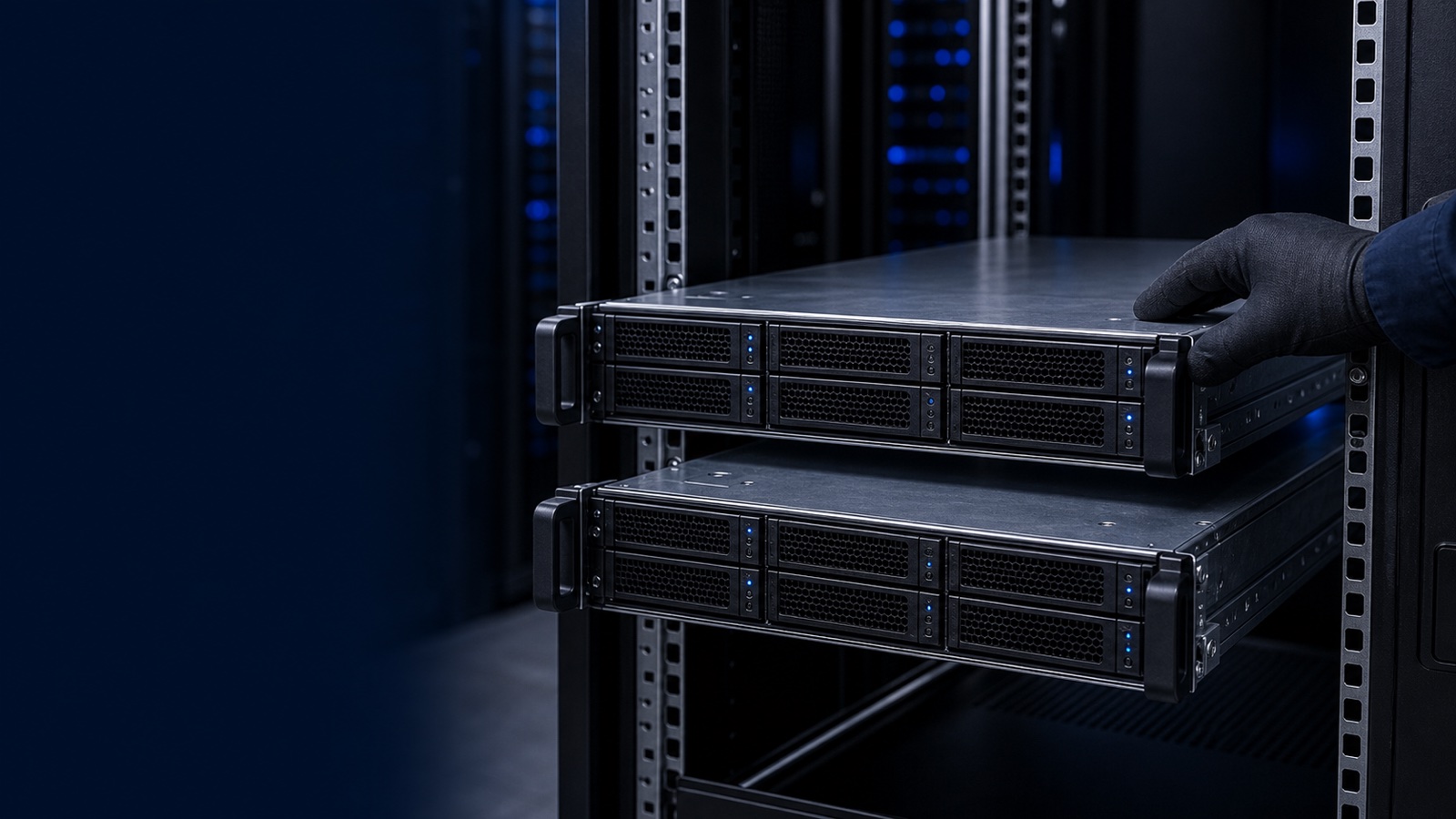
If you are standardizing a rack server fleet for a data center, an agency, or a hospital, the short list almost always comes down to two platforms: Dell PowerEdge and Lenovo ThinkSystem. Both run the same Intel Xeon and AMD EPYC silicon, both ship in familiar 1U and 2U form factors, and both have credible enterprise track records. The decision rarely turns on raw spec sheets. It turns on three things that determine your actual operating cost over a five- to seven-year lifecycle: rack density, reliability and serviceability (RAS), and how the platform fits your support and procurement model.
This is a head-to-head on those three axes, written for the people who have to live with the choice: sysadmins who manage the fleet, IT directors who own the budget, and contracting officers who have to put it on a contract.
Density: 1U and 2U mainstream compute
Dell's volume rack servers are the PowerEdge R660 (1U) and PowerEdge R760 (2U), built on Intel Xeon Scalable, with AMD EPYC equivalents (the R6615/R6625 and R7615/R7625 families) for core-heavy and price-performance workloads. Lenovo's comparable mainstream units are the ThinkSystem SR630/SR650 generations.
For most buyers, the meaningful density questions are not "how many cores fit" — both vendors track the same CPU roadmaps — but how the chassis is engineered around them:
- Drive and NVMe flexibility. The 2U PowerEdge R760 supports dense all-NVMe front-bay configurations, which matters when you are consolidating virtualization or running storage-adjacent workloads close to compute. Confirm the exact backplane and bay count per config, because density claims live or die on the specific SKU.
- GPU and accelerator headroom. If your roadmap includes AI inference or VDI, look at how many double-width accelerators each 2U chassis sanctions with full thermal support, not just physical fit. Dell's broader PowerEdge XE line (such as the XE9680) exists specifically for GPU-dense AI, so you are not forced to over-stretch a general-purpose 2U.
- Thermal and power envelope. Higher-TDP CPUs increasingly require validated airflow or direct liquid cooling. Both vendors offer liquid-cooled options; the practical question is whether your facility's rack and your reseller's configuration desk can deliver a validated, supportable design rather than a paper config.
Density verdict: it is close, and at the single-node level the platforms trade blows. PowerEdge tends to win on breadth of validated configurations — there is usually a tested PowerEdge layout for the exact density profile you need, which reduces the risk of a one-off design that support won't fully stand behind.
RAS: reliability, availability, serviceability
This is where day-two operations are decided. Both PowerEdge and ThinkSystem deliver the enterprise RAS table stakes — redundant hot-plug power and fans, ECC memory, tool-less drive service, and hardware root-of-trust boot protection. The differentiators are in the details of how predictable and self-documenting the platform is:
- Boot and firmware integrity. PowerEdge implements a silicon-based root of trust with cryptographically verified firmware and automatic recovery of corrupted BIOS/firmware. For regulated environments, the value is not just the feature — it is the documentation and consistency across the whole rack line.
- Predictive failure and telemetry. Modern fleets run on telemetry. PowerEdge surfaces component health and predictive-failure data through iDRAC and OpenManage so a failing DIMM or drive is flagged before it takes a node down. ThinkSystem offers comparable predictive analytics through XClarity.
- Field serviceability. Both are tool-less for routine parts. The operational question is parts logistics and how fast a vetted technician with the right SKU reaches your site — which is a support-contract question more than a chassis question (see below).
RAS verdict: feature parity is real, but PowerEdge's advantage is consistency. The same security and telemetry model runs from a single 1U edge node to a dense 2U virtualization host, so your runbooks, monitoring integrations, and compliance evidence are uniform across the fleet.
Management: OpenManage/iDRAC vs XClarity
For a fleet, the management plane is the product. You will spend far more hours in the console than you ever will swapping hardware.
Dell pairs the iDRAC baseboard controller (per-server, agent-free, with a dedicated out-of-band port) with OpenManage Enterprise for fleet-wide monitoring, firmware lifecycle, and configuration drift control. iDRAC's automation hooks (Redfish-conformant APIs) make it straightforward to wire PowerEdge into Ansible, ServiceNow, or your own provisioning pipeline.
Lenovo offers XClarity Controller at the node level and XClarity Administrator for fleet management, with a similar Redfish-based automation story.
What to weigh:
- Firmware lifecycle at scale. Staged, validated firmware baselines you can push fleet-wide — and roll back — are the feature that actually saves weekends. Evaluate both vendors' catalog-driven update tooling against your patch cadence.
- Licensing tiers. Advanced remote features (virtual console, richer telemetry, automation) often sit behind a higher controller license on both platforms. Price the tier you will actually use, not the base SKU.
- Existing investment. If your team already lives in OpenManage or XClarity, the switching cost is real. Continuity is a legitimate tiebreaker.
Management verdict: both are mature and automatable. iDRAC plus OpenManage tends to feel more turnkey out of the box for mixed Dell estates (servers, PowerStore, PowerSwitch under one operational umbrella), which is the more common reality in federal and healthcare data centers.
Support and federal availability
For US federal, DoD, SLED, and healthcare buyers, this axis frequently decides the whole comparison.
- Procurement. Dell PowerEdge is broadly available to federal, DoD, and SLED buyers, quoted by RFQ. Buying through an authorized partner keeps the order on a compliant path and the paperwork clean.
- TAA and supply-chain integrity. Verify Trade Agreements Act compliance and Section 889 considerations on the specific configuration. A configured PowerEdge order placed through an authorized reseller comes with a defensible, auditable supply chain — which matters for NIST 800-171 and agency security reviews.
- Security baselines. Where FIPS 140-3 validated cryptographic modules or specific hardening are required, confirm them at the component and config level rather than assuming platform-wide coverage.
- Support tiers. Dell ProSupport and ProSupport Plus (with predictive, parts-included service) map cleanly to mission-uptime requirements. Match the response SLA to the workload, not to the cheapest line item.
The practical takeaway
PowerEdge and ThinkSystem are both legitimate enterprise platforms, and at the single-node level the gap is narrow. PowerEdge pulls ahead where it counts for most regulated buyers: a deep bench of validated density configurations, a uniform RAS and security model across the whole rack line, a turnkey iDRAC/OpenManage management plane, and clean availability on the federal contracts you are already authorized to use. If your environment is mixed Dell, or compliance and auditability are non-negotiable, PowerEdge is the lower-risk standard.
The right answer still depends on your workloads, your existing tooling, and your contract. If you want a PowerEdge configuration sized to your density, RAS, and SLA targets — quoted by RFQ — request a quote or talk to a Uniqcli specialist. We will spec it to your requirements and keep the procurement compliant.