
Dell PowerEdge 16G vs 17G: R760/R660 vs R770/R670 and When to Upgrade
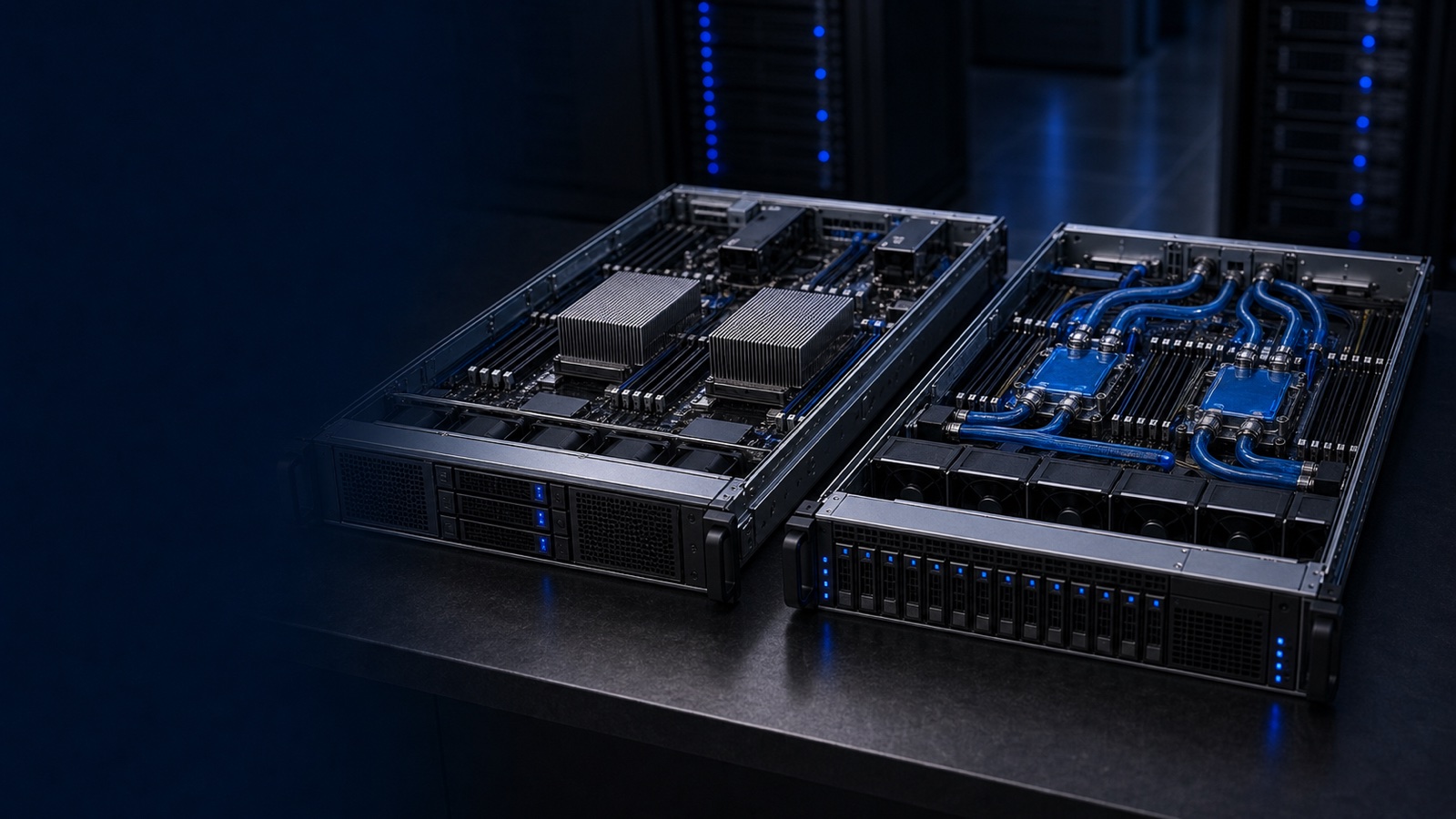
When Dell introduced the PowerEdge 17th Generation (17G) portfolio, it was not a quiet silicon bump on top of the well-established 16th Generation (16G) line. Dell moved to Intel Xeon 6 and 5th Gen AMD EPYC processors, shipped a redesigned iDRAC10 management controller, widened PCIe Gen5 and NVMe density, and made direct liquid cooling a mainstream factory option across the rack lineup.
For teams running 16G hardware such as the PowerEdge R660 (1U) and R760 (2U), the practical question is whether the 17G R670 (1U) and R770 (2U) justify a refresh now, or whether 16G still has years of useful runway. The honest answer depends on your workload mix, your compliance posture, and how hard you are pushing toward AI inference, dense virtualization, and power-constrained builds. This guide breaks down what actually changed and helps you build, or table, the upgrade case.
Processor Architecture: Intel Xeon 6 Raises the Core Ceiling
The foundational difference is the CPU platform. 16G servers ship with 4th and 5th Gen Intel Xeon Scalable processors, well-proven parts that handle the vast majority of enterprise workloads without complaint, topping out near 64 cores per socket.
17G moves to Intel Xeon 6, which splits into two sub-families: P-cores (performance-optimized, up to 86 P-cores per socket) and E-cores (efficiency-optimized, up to 144 E-cores per socket). The dual-socket R670 and R770 can therefore deliver up to 86 P-cores or 144 E-cores across two sockets, a substantial jump in maximum thread density.
In practice:
- Cloud-native and container workloads scale efficiently on E-core configurations, where threads-per-watt is the dominant metric.
- Latency-sensitive database and HPC workloads benefit from the higher single-thread performance of P-core variants.
- AI inference becomes viable in a 1U or 2U footprint when you can pack that many cores without adding nodes. Dell Performance Labs has reported roughly 67% SpecCPU integer throughput gains on R670/R770 versus prior-generation R660/R760.
On the AMD side, 17G adds 5th Gen AMD EPYC (Turin) models, the R6715/R6725 (single-socket) and R7715/R7725 (dual-socket), targeting virtualization, VDI, and container-heavy estates with high core counts and large DDR5 capacity.
Memory, PCIe, and NVMe: More Bandwidth, More Slots, More Flash
17G raises DDR5 speed and, more importantly, increases usable high-speed I/O. Both generations support PCIe Gen5, but the R670 and R770 expand usable Gen5 slot density, which matters when you are deploying 100/200/400Gb networking, GPUs, or NVMe-oF fabrics. For reference, the 16G R760 already offers more expansion than the R660 (roughly four Gen5 plus eight Gen4 slots versus the R660's two Gen5 plus three Gen4); 17G builds further on that.
Storage density also improves. The 16G R660 supports up to 16 E3.S Gen5 NVMe drives, while the 17G R670 supports up to 20 front E3.S NVMe drives plus 2 rear, and the 2U R770 scales higher still. For organizations building dense all-flash tiers without a dedicated array, common in healthcare imaging, federal data repositories, and financial transaction databases, that extra density can eliminate external enclosures in many designs.
| Specification | 16G (R660 / R760) | 17G (R670 / R770) |
|---|---|---|
| Intel processor | Xeon Scalable 4th/5th Gen | Intel Xeon 6 (P-core / E-core) |
| Max cores (Intel) | ~64 per socket | Up to 86 P-cores / 144 E-cores per socket |
| AMD processor | 4th Gen EPYC (Genoa) | 5th Gen EPYC (Turin) |
| PCIe Gen5 | Yes | Yes, higher usable slot density |
| E3.S NVMe (1U) | Up to 16 (R660) | Up to 20 front + 2 rear (R670) |
| Management | iDRAC9 | iDRAC10 (AI-enabled) |
| Firmware cadence | Biannual BIOS/iDRAC | Quarterly BIOS/iDRAC |
Security: iDRAC10 Is a Generational Leap
Security is where 17G makes the clearest upgrade argument, and it matters most for federal, DoD, healthcare, and SLED buyers. iDRAC9 already delivers a hardware silicon root of trust, secured boot, and FIPS-validated cryptography. iDRAC10 extends that foundation:
- Silicon-based root of trust on a dedicated, FIPS 140-3 certified controller (Nuvoton Arbel), with device-level attestation and a dedicated secure enclave subsystem managing cyber-resiliency functions.
- Stronger cryptography, including SHA-384/SHA-512 authentication and AES-256 for data privacy.
- Post-quantum readiness. Dell is adopting the Leighton-Micali Signature (LMS) algorithm from NIST SP 800-208 (CNSA 2.0 approved) for firmware signing, with quantum-resistant firmware validation rolling into production PowerEdge platforms beginning in 2026, addressing "harvest now, decrypt later" risk.
- TLS 1.3 with FIPS certification across 16G and 17G, plus 17G additions such as Intel Trust Domain Extensions for stronger workload isolation and Zero Trust maturity.
For agencies tracking CMMC Level 2/3, organizations under HIPAA audit and accountability controls, or SLED buyers aligning to NIST CSF 2.0, the iDRAC9-to-iDRAC10 gap is operational, not cosmetic, and it simplifies control-mapping during assessments.
Cooling and Efficiency: Liquid Becomes Mainstream
16G is predominantly air-cooled in standard configurations. 17G makes direct liquid cooling a broadly supported factory option across the rack portfolio, which matters as high-core-count Xeon 6 and EPYC Turin configurations push heat profiles that stress air cooling in dense racks. For data centers running at power or cooling limits, common in federal and SLED facilities, liquid-cooled 17G nodes enable higher compute density in the same footprint without facility upgrades. Even in air-cooled deployments, 17G's efficiency improvements lower per-server power draw versus older generations.
Lifecycle Management: Dell CloudIQ and APEX AIOps Observability
Both generations manage through Dell OpenManage Enterprise and connect to Dell CloudIQ / APEX AIOps Observability, Dell's cloud-based, ML-driven monitoring platform. Through the OpenManage Enterprise plugin, it ingests iDRAC telemetry (CPU, memory, I/O, thermals, power) to proactively surface health and performance anomalies, shorten time-to-resolution, and drive fleet-wide firmware updates across sites. It is available at no extra charge with a valid ProSupport (or higher) contract. Paired with iDRAC10's deeper runtime telemetry, 17G positions operations teams for predictive, rather than reactive, infrastructure management.
When to Upgrade: A Practical Framework
16G remains fully supported and high-performing. The question is whether your environment makes a near-term case to move.
Move to 17G now if: you have compliance drivers pointing at FIPS 140-3, CNSA 2.0 / post-quantum readiness, or Zero Trust isolation; you run AI inference or analytics that saturate current cores or PCIe/GPU capacity; you need NVMe density beyond what 16G offers in 1U/2U; hardware is approaching end of warranty or you are deploying net-new; or your facility is power/cooling constrained and consolidation onto denser nodes would free capacity.
Stay on 16G if: workloads are stable with healthy utilization and 2-3 years of depreciation remaining; your compliance framework does not yet require the newer controls; or you are mid-cycle on a software platform where recertification or relicensing would offset near-term hardware savings.
How Uniqcli Helps
As an authorized Dell Technologies partner serving federal, DoD, SLED, healthcare, and enterprise customers, Uniqcli does more than source hardware. Our technical team can model workload-specific differences between 16G and 17G configurations, navigate Dell financing and leasing, and place TAA-compliant orders, quoted by RFQ, the way your procurement rules require. Whether you are weighing an R760 refresh against an R770 investment or sourcing EPYC Turin nodes for VDI consolidation, request a quote or contact our team. We respond within one business day with detailed BOMs, lead-time estimates, and configuration guidance at no cost.