
Dell PowerEdge R660 vs R760: Choosing Between 1U and 2U Rack Compute
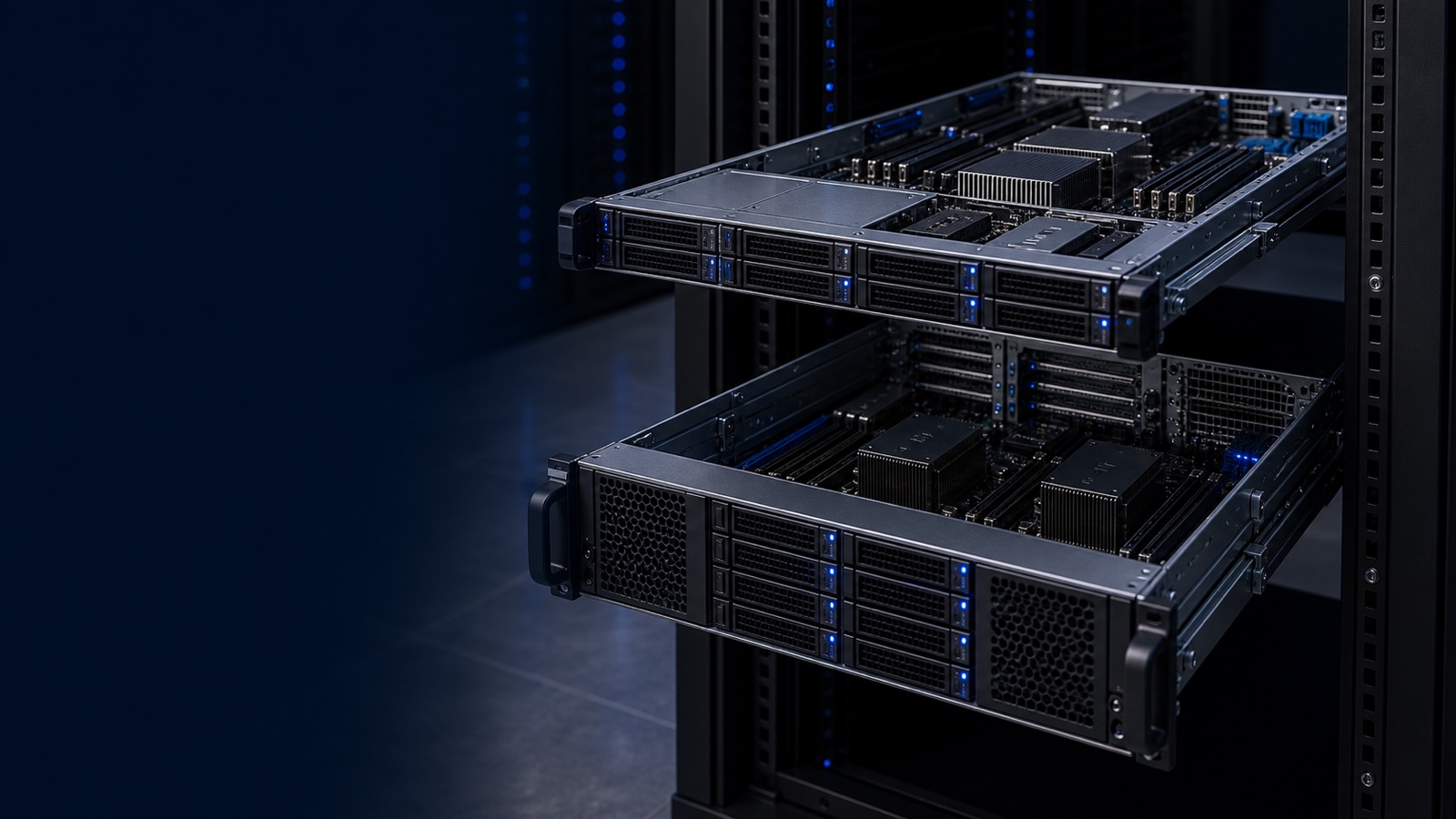
The Dell PowerEdge R660 and R760 are the two workhorses of Dell's current-generation 16G rack portfolio. Both run the same Intel Xeon Scalable processors, share the same iDRAC management stack, and serve the same broad audience: virtualization clusters, databases, application tiers, and the back-end of nearly every enterprise and federal data center. The defining difference is physical. The R660 is a 1U server built for density; the R760 is a 2U server built for expansion. Almost every other decision flows from that single dimension. This guide walks through where each one wins so you can standardize on the right platform instead of over-buying chassis you don't need.
The R660: Maximum Compute Density in 1U
The PowerEdge R660 packs two Xeon Scalable processors into a single rack unit. For organizations measured on rack space, power, and cooling efficiency, that density is the whole point. You can fit roughly twice as many R660 nodes into the same rack height as a comparable 2U server, which matters enormously in colocation facilities billed by the U, in space-constrained government server rooms, and in scale-out clusters where node count drives the design.
The trade-off is expansion headroom. A 1U chassis limits how many PCIe cards, drives, and full-height accelerators you can install. The R660 still supports NVMe storage, modern networking, and ample memory across its DIMM slots, but it is optimized for compute-dense roles: virtualization hosts, web and application servers, HPC nodes, and software-defined infrastructure where each node stays relatively uniform and storage or GPUs live elsewhere in the architecture.
The R760: Room to Grow in 2U
The PowerEdge R760 uses the same dual-socket Xeon foundation but gives that silicon far more room to breathe. The 2U chassis roughly doubles the available PCIe expansion slots, supports a substantially larger drive count across SAS, SATA, and NVMe, and accommodates the thermal and power envelope required for GPU acceleration. If you intend to run AI inference, virtual desktop infrastructure, GPU-assisted analytics, or any workload that needs multiple high-bandwidth add-in cards, the R760 is the platform that physically fits them.
That flexibility also makes the R760 the safer choice when future requirements are uncertain. Storage-heavy databases, consolidation projects, and mixed-workload virtualization clusters all benefit from the additional drive bays and slots. You pay for that capability in rack height and, typically, in power draw per node, but you gain a server that adapts rather than one you outgrow in 18 months.
Specification Trade-Offs at a Glance
Both servers share processor generation, memory technology, iDRAC9 with Lifecycle Controller, and Dell's hardware root-of-trust security model. The meaningful differences cluster around physical capacity:
- Form factor: R660 is 1U; R760 is 2U.
- PCIe expansion: The R760 offers roughly twice the slot count, including support for full-height, double-width GPUs that the R660 cannot house.
- Storage: The R760 supports a higher maximum drive count and more flexible bay configurations; the R660 favors compact all-NVMe or hybrid layouts.
- GPU and acceleration: Serious GPU work belongs in the R760. The R660 is best treated as a CPU-first node.
- Density and power: The R660 wins on nodes-per-rack and rack efficiency; the R760 wins on per-node capability.
How to Choose: A Practical Decision Framework
Start with the workload, not the spec sheet. Choose the R660 when you are building out a large fleet of uniform compute nodes, when rack space or colocation cost is a hard constraint, or when storage and acceleration are handled by a separate tier such as Dell PowerStore or PowerMax. It is an excellent default for virtualization hosts, HCI building blocks, and horizontally scaled application clusters.
Choose the R760 when a single node must do more: heavy local storage, GPU acceleration, multiple network or HBA cards, or consolidation of several legacy boxes into one. It is also the more defensible pick when your three-year roadmap is fuzzy, because the expansion headroom absorbs change without a chassis swap.
A common, well-balanced pattern is to mix both: R660 nodes for the compute plane and R760 nodes where storage density or GPUs are required. Because they share a management and security model, a mixed fleet stays operationally consistent.
How Uniqcli Helps
Uniqcli is an authorized Dell Technologies reseller, and we configure PowerEdge R660 and R760 platforms to fit the workload rather than the brochure. For public-sector buyers, we provide TAA-compliant configurations, quoted by RFQ, so federal, DoD, and SLED teams can acquire the right rack platform on a compliant path. For healthcare and enterprise customers, we help right-size processor, memory, storage, and acceleration options, and pair them with the appropriate Dell ProSupport tier.
If you are standardizing a refresh or scaling a new cluster, reach out to Uniqcli for a configuration review. We will help you decide where 1U density serves you best and where the 2U expansion of the R760 is worth the extra rack height, before you commit to a fleet-wide design.